



When organisations begin a digital project, one of the first things that happens is a request for quotes.
Several agencies respond. Proposals arrive with different price points. And inevitably, the conversation turns to cost.
At first glance, software development can appear straightforward to compare. One proposal might be significantly cheaper than another. The assumption is often that both vendors are building the same thing, so the lower price represents better value.
Unfortunately, that assumption is rarely true.
In reality, the difference between a high-quality engineering approach and a low-cost build often only becomes visible months or years later.
And by that point, the real cost begins to surface.
When the “cheap” option becomes expensive
At Newpath, we regularly meet organisations that come to us after working with another development partner.
The story is often similar. The original project looked successful at the time. The system was launched, the functionality appeared to work, and the budget was met.
But over time, problems begin to emerge.
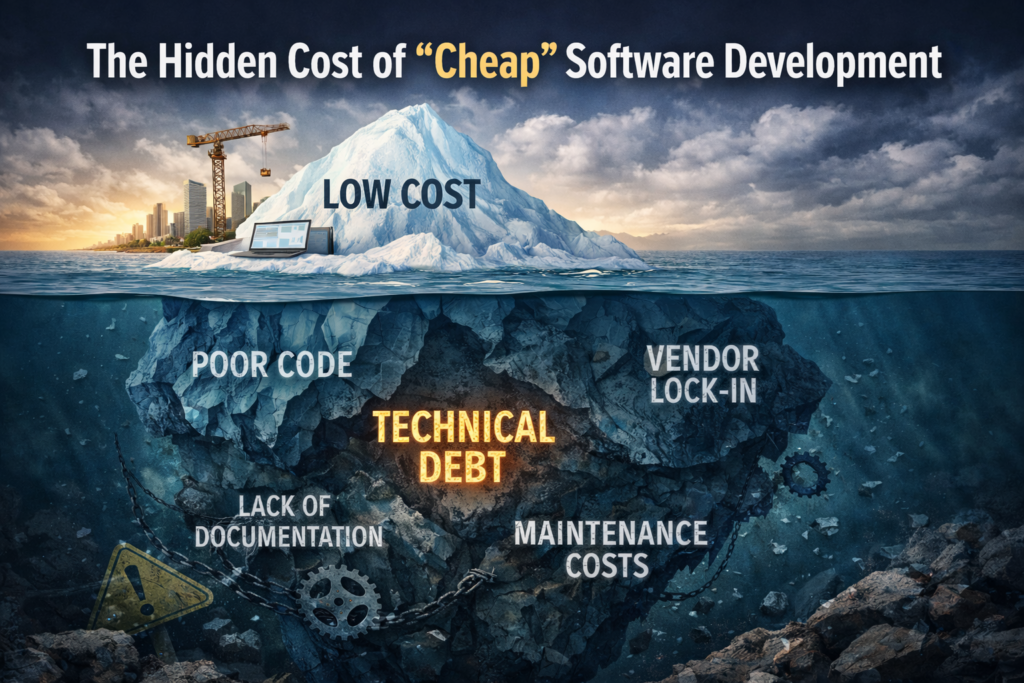
The platform becomes difficult to maintain. New features take longer than expected to build. Simple changes require extensive work. Eventually, the organisation finds itself locked into a system that is far more expensive to evolve than it ever was to build.
In many cases, the issue isn’t the idea behind the platform. It’s the way the software was engineered.
What goes wrong behind the scenes
Software quality is not always visible from the outside.
A system may look polished on launch day, but underneath the surface there may be structural issues that only appear later. These can include things like:
-
poorly structured or undocumented code
-
tightly coupled components that make changes risky
-
missing automated testing
-
inadequate architecture for future growth
-
lack of technical documentation
-
unclear ownership of the underlying platform
When these issues exist, every future enhancement becomes harder and more expensive.
What should be straightforward improvements turn into complex redevelopment work.
The cost of technical debt
In software engineering, this situation is often described as technical debt.
Technical debt occurs when short-term decisions are made during development that create long-term complexity. Sometimes this happens because projects are rushed. Sometimes it occurs because the development team lacks the experience to design scalable systems.
Either way, the result is the same.
The organisation pays for those shortcuts later.
Over time, teams spend more effort maintaining the system than improving it.
Vendor lock-in: the hidden risk
Another common issue we see is vendor lock-in.
This occurs when a development partner retains control over key parts of the platform, such as:
-
the source code repository
-
hosting environments
-
deployment processes
-
intellectual property ownership
-
system documentation
When these elements are not clearly defined, organisations can find themselves in a difficult position if they ever want to change vendors.
Moving the platform becomes complicated, expensive, or in some cases impossible without rebuilding significant parts of the system.
Healthy development partnerships should never depend on lock-in.
Clients should stay with a technology partner because they receive value, not because leaving is difficult.
What high-quality software development looks like
Strong engineering practices rarely make headlines, but they make an enormous difference over time.
Well-built software platforms typically share a few common characteristics:
-
clear and maintainable architecture
-
well-structured, readable code
-
proper documentation
-
automated testing
-
scalable infrastructure
-
transparent ownership of assets and environments
These practices require more thought during the development phase, but they dramatically reduce long-term cost and risk.
In other words, the goal is not simply to build software that works today.
The goal is to build software that continues to work well as the organisation evolves.
Choosing a development partner
When evaluating a development partner, cost will always be part of the discussion. That’s natural.
But it should not be the only factor.
Organisations should also ask questions such as:
-
How is the platform architected for long-term scalability?
-
Who owns the intellectual property and source code?
-
How will the system be maintained and extended in the future?
-
What documentation will exist when the project is complete?
-
How easy would it be to transition to another vendor if needed?
These questions often reveal far more about the true value of a proposal than the initial price.
The real measure of success
A successful digital platform is not defined by launch day.
It is defined by how effectively it supports the organisation over the years that follow.
Software should enable growth, innovation, and change. It should not become a constraint that slows progress or increases operational complexity.
When development is approached with long-term thinking, organisations avoid the hidden costs that so often appear after the project has been delivered.
And in the end, that is what true value looks like.