



E-commerce, MS Dynamics integration, Nintex, personalisation, marketing automation, 360 tours, learning platform
Drupal, Microsoft Dynamics, Click Dimensions

AACS
Overview
The aged care sector is under sustained and increasing pressure to perform.
Regulatory expectations continue to rise. Funding models are becoming more complex and more tightly scrutinised. Workforce shortages and cost pressures are forcing providers to operate with greater efficiency. At the same time, there is an expectation of improved transparency, better reporting, and consistently high standards of care.
In this environment, data should be a strategic asset. For most organisations, it is not.
Aged care providers generate large volumes of data across financial systems, workforce platforms, government reporting channels and operational systems. However, that data is rarely structured in a way that supports real-time decision-making. It is fragmented, often inconsistent, and typically locked inside individual systems that were never designed to work together.
The result is an industry that is data-rich but insight-poor.
Applied Aged Care Solutions (AACS) identified this gap and engaged Newpath to design and build a new software platform from the ground up. The goal was not to improve reporting at the margins, but to fundamentally change how aged care providers interact with their data.
The result is the Operations Insights Suite, a purpose-built operational intelligence platform designed specifically for the Australian aged care sector. The platform consolidates data from multiple systems into a unified environment and transforms that data into actionable insight that can be used across facilities, regions and executive teams.
This is not a reporting layer added on top of existing systems. It is a new category of software designed to embed intelligence into the daily operation of aged care organisations.
AACS
The challenge
The starting point for the project was a complex and fragmented data environment.
Aged care providers operate across multiple systems, each responsible for a different part of the business. Financial systems manage revenue, expenses and reporting. Government platforms provide funding and compliance data. Workforce systems handle rostering, staffing and payroll. Operational systems track residents, care requirements and facility activity.
Each system generates data, but none provide a complete view of the organisation.
This creates a number of structural challenges.
Data fragmentation is the most obvious issue. Information is distributed across systems with different formats, structures and definitions. There is no consistent way to combine this data without significant manual effort.
Manual reporting processes are a direct consequence. Teams are required to extract data from multiple systems, reconcile inconsistencies, restructure datasets and build reports manually. This process is time-consuming and introduces risk at every stage.
Timeliness is another problem. Reporting is typically retrospective. By the time information reaches decision-makers, it reflects what has already happened rather than what is currently happening. This limits the ability to respond quickly to emerging issues.
There is also a fundamental disconnect between data and action. Traditional reporting tools present information but do not support decision-making workflows. They do not guide users on what to do next or how to respond to what they are seeing.
Finally, there is the issue of sector specificity. Aged care operates within frameworks such as AN-ACC, care minute requirements and strict compliance obligations. Generic business intelligence tools are not designed to reflect these frameworks in a meaningful way.
Taken together, these challenges meant that improving reporting processes alone would not be sufficient. A different approach was required.
AACS
The vision
The vision for the Operations Insights Suite was clear from the outset.
The platform needed to move beyond reporting and become an operational system in its own right.
It needed to provide a single, structured environment where data from multiple systems could be consolidated, analysed and acted upon in real time. It needed to support different user roles across the organisation, from facility managers through to executive leadership. It needed to reduce manual effort while increasing the speed and quality of decision-making.
Importantly, it also needed to be designed specifically for aged care.
This meant incorporating sector-specific logic, terminology and workflows into the platform. It meant designing around real operational needs rather than theoretical reporting models. It meant creating a system that could evolve over time, moving from foundational analytics into predictive and AI-driven capability.
The goal was not to build a better dashboard. The goal was to build a platform that could become central to how aged care organisations operate.
AACS
Platform architecture and design approach
To achieve this, Newpath designed the platform using a modular, service-oriented architecture.
At the centre of the platform is a consolidated data layer that integrates information from multiple external systems. This layer is responsible for ingesting, validating, structuring and storing data in a consistent format. It acts as the foundation for all reporting, analytics and workflows.
On top of the data layer sit a series of application services that deliver functionality across different domains. These services are responsible for processing data, applying business logic, generating insights and supporting workflows.
The presentation layer provides the user interface, delivering dashboards, reports and operational views tailored to different user roles.
This separation of concerns ensures that the platform is scalable, maintainable and flexible. It allows individual components to evolve without impacting the entire system.
Integration with external systems is handled through APIs, allowing data to flow into the platform in a structured and repeatable way. This reduces reliance on manual data handling and ensures that information remains current.
The platform has been designed to support multi-tenant environments, allowing it to scale across multiple providers and facilities. It has also been built with security as a core principle, ensuring that sensitive data is protected at all times.
AACS
Core platform capabilities
The Operations Insights Suite brings together multiple operational domains into a single environment, each designed to address a specific aspect of aged care performance.
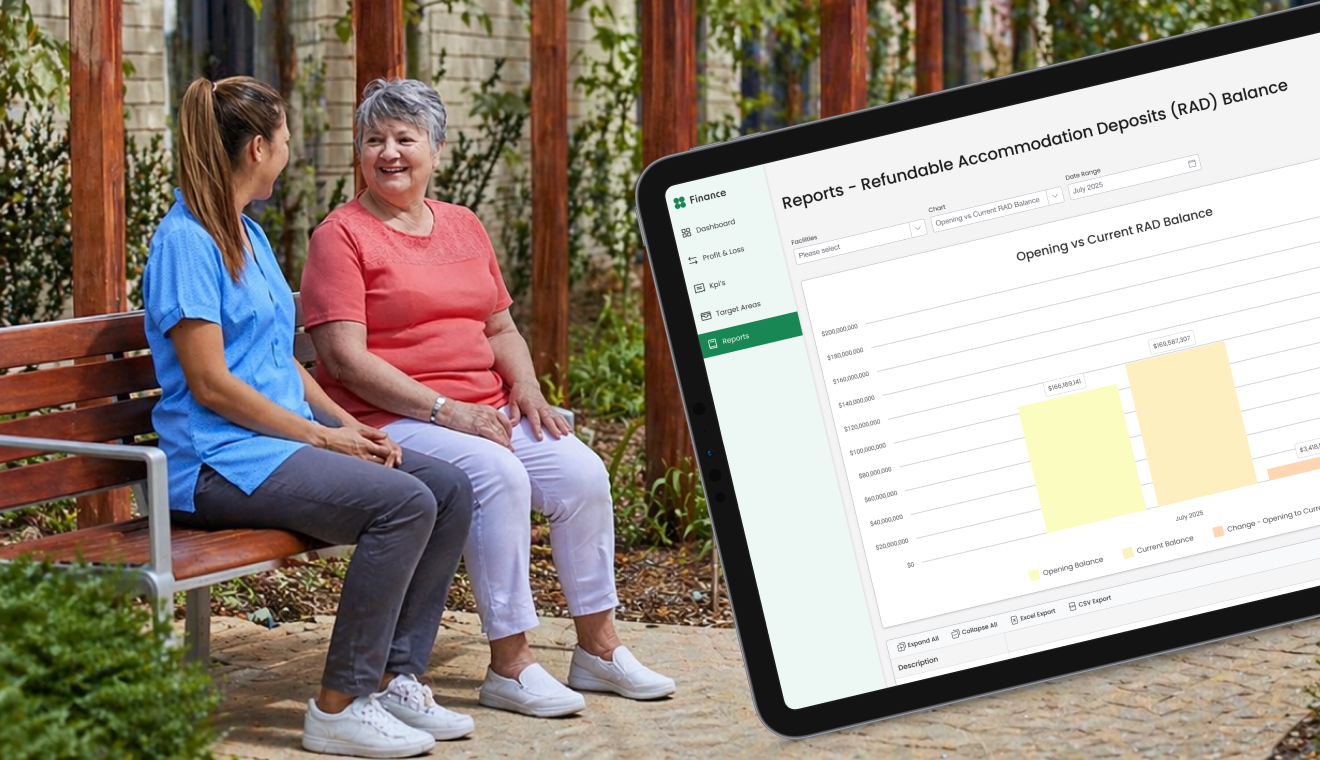
The finance domain provides a structured view of financial performance across the organisation. Data from accounting systems and benchmarking sources is consolidated into a unified reporting environment. Users can access Profit and Loss statements, Balance Sheets, Cash Flow reports and KPI dashboards. They can compare performance against budget, analyse trends over time and drill down into specific accounts or facilities. This reduces reliance on manual reporting and provides a clearer understanding of financial performance.
The resident and funding domain incorporates data aligned with Australian aged care frameworks. This includes AN-ACC classifications, site acuity profiles, demographic insights, admission and departure trends, length of stay analysis and supported resident days. By structuring this data within the platform, providers can better understand how resident mix impacts funding and operational performance.
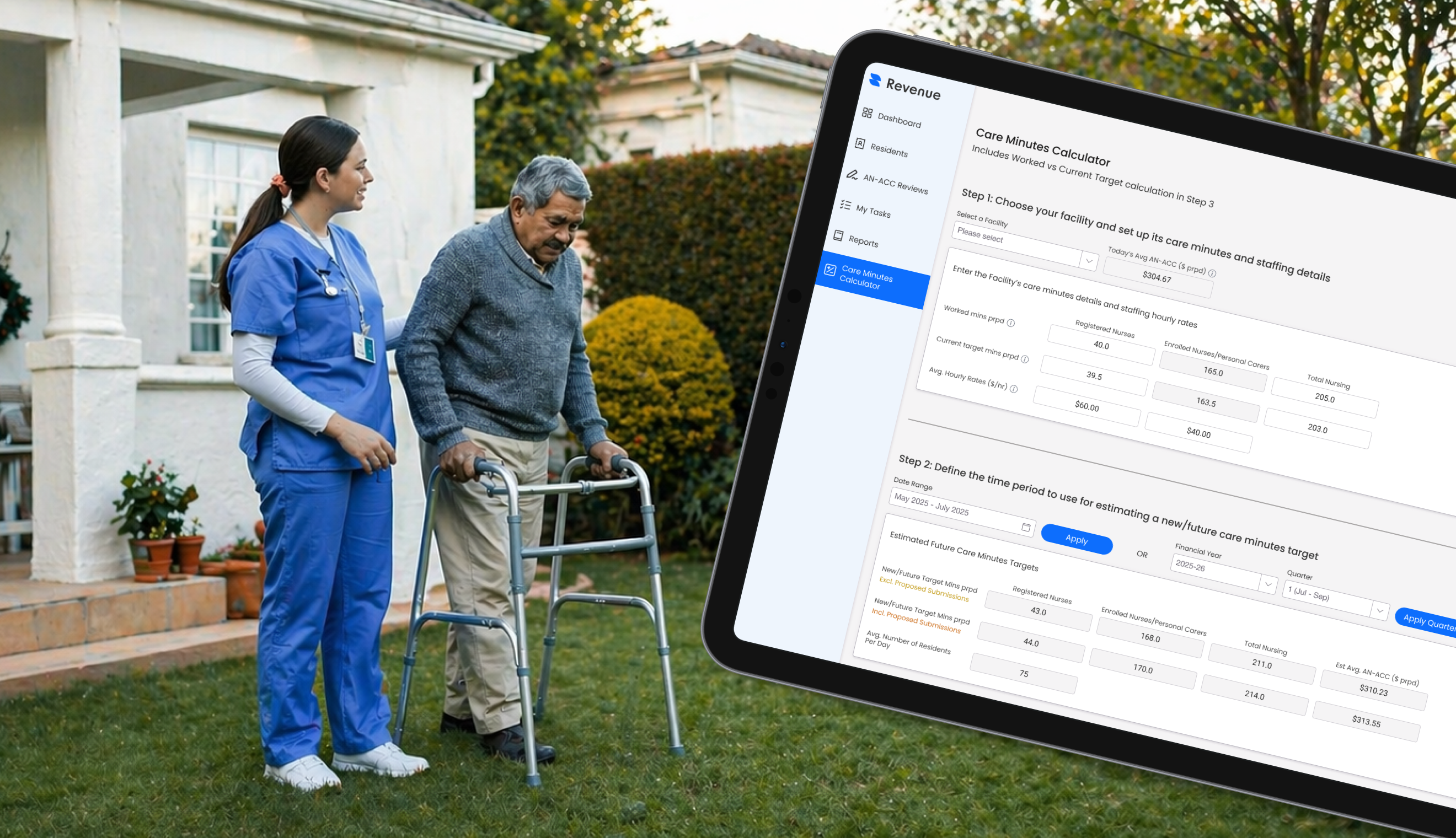
The AN-ACC workflow capability is a key differentiator. Rather than simply reporting on classifications, the platform supports operational workflows that allow providers to actively manage funding outcomes. Users can perform resident-level reviews, model different scenarios, assess care needs and understand the financial implications of changes. This moves the platform from passive reporting into active management.
AACS
Data handling and intelligence layer
One of the most important aspects of the platform is how it handles data.
Data is not simply aggregated and displayed. It is processed, structured and contextualised.
The platform performs data validation and cleansing to ensure accuracy. It applies consistent data models to standardise information from different sources. It links data across domains, allowing relationships to be identified and analysed.
This creates a foundation for more advanced analytics.
Because the data is structured and consistent, it can be used to identify trends, detect anomalies and support predictive modelling. Over time, this enables the introduction of AI-driven insights and automated decision support.
This is a critical shift. It moves the platform from being a reporting tool to being an intelligence engine.
AACS
User experience and operational alignment
A key focus of the platform has been usability.
Different users require different types of information. A facility manager needs immediate visibility into operational issues. A finance team requires structured reporting and data integrity. An executive needs high-level insights and trend analysis.
The platform addresses this through role-based access and tailored user interfaces.
Dashboards can be customised to present relevant information to each user. Navigation is designed to allow users to move quickly between high-level views and detailed analysis. Alerts and notifications highlight areas that require attention.
Workflows are integrated into the platform, guiding users through specific processes. This ensures that the system is not just used for analysis, but as part of day-to-day operations.
The goal has been to create a system that is both powerful and practical.
AACS
Technology and security
The platform has been built on a modern technology stack designed to support performance, scalability and security.
It is deployed in a cloud-based environment, allowing access from multiple locations without the need for on-premise infrastructure. Data is hosted in Australia, ensuring compliance with local requirements.
Security measures include network segmentation, firewall protection, role-based access controls and secure authentication mechanisms. Integration with Microsoft Azure identity services provides additional layers of security and flexibility.
These measures ensure that sensitive financial, operational and resident data is protected while remaining accessible to authorised users.
AACS
The outcome
The Operations Insights Suite has delivered a significant shift in how aged care providers manage their operations.
Data that was previously fragmented and difficult to access is now consolidated and structured. Reporting processes that were manual and time-consuming are now more automated and efficient. Decision-making is faster and better informed.
Users across the organisation have access to the information they need, when they need it. They can understand performance, identify issues and take action with greater confidence.
The platform also provides a foundation for future capability. As it evolves, it will incorporate predictive analytics, AI-driven insights and greater levels of automation.
AACS
Strategic impact
The impact of the platform extends beyond immediate operational improvements.
It enables organisations to move toward a more data-driven model of management. It supports better financial performance through improved visibility. It enhances workforce planning and resource allocation. It provides a clearer understanding of funding and revenue drivers.
It also strengthens organisational resilience. By providing early visibility into risks and performance issues, the platform allows providers to respond more effectively to changing conditions.
In a sector facing ongoing pressure, this level of capability is a significant advantage.
AACS
Conclusion
The Operations Insights Suite represents a fundamental shift in how aged care providers can use technology.
Newpath worked with AACS to design and build a platform from the ground up, tailored specifically to the needs of the sector. The result is a system that transforms data into intelligence and intelligence into action.
It is not simply an improvement on existing approaches. It is a new way of thinking about how aged care organisations operate.