



AI Code Looks Great in Review. Production Tells a Different Story.
Artificial intelligence has changed software development faster than almost any technology in the past decade.
Today, developers can generate entire functions, API integrations, database queries and user interfaces in seconds. Tasks that once took hours can often be completed in minutes. The productivity gains are real, and organisations across Australia are embracing them.
But there is an important distinction emerging in software teams around the world:
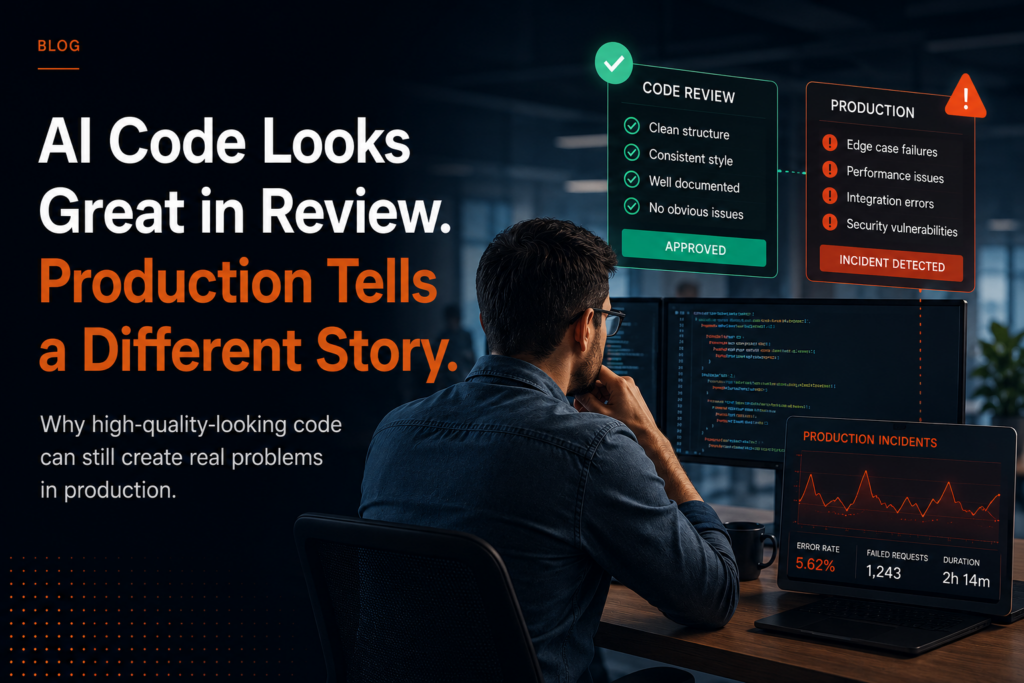
AI-generated code often looks excellent during review, yet creates disproportionately more problems once it reaches production.
That’s not because AI writes bad code.
It’s because software quality has never been determined solely by what the code looks like.
The illusion of quality
Ask most developers to review AI-generated code and they’ll often be impressed.
The code is usually:
- Well formatted
- Consistently structured
- Easy to read
- Well commented
- Free of obvious syntax errors
Compared to code written by humans under pressure, AI-generated output can appear cleaner and more polished.
This creates a subtle risk.
Teams begin equating readability with quality.
Unfortunately, production systems don’t care how elegant the code looks.
They care whether it behaves correctly under real-world conditions.
Software doesn’t fail in code review
Most software failures occur because of circumstances that are difficult to see in a pull request.
Examples include:
- Unexpected user behaviour
- High transaction volumes
- Concurrency issues
- Complex business rules
- Third-party integration failures
- Authentication edge cases
- Data consistency problems
- Regulatory and compliance requirements
These are precisely the areas where AI tools have limited visibility.
Large language models generate code based on patterns found in training data. They don’t understand your organisation’s architecture, operational history, customer behaviour or risk profile.
As a result, the code often performs well under ideal conditions but struggles at the edges where real businesses operate.
Australian organisations face a unique challenge
Many discussions about AI coding focus on Silicon Valley technology companies.
Australian businesses operate in a different environment.
Local organisations often have:
- Smaller engineering teams
- Leaner operational budgets
- More complex legacy systems
- Strict privacy obligations
- Industry-specific compliance requirements
When a production issue occurs, there may not be an army of engineers available to investigate and remediate it.
The cost of failure can be significant.
A poorly implemented AI-generated integration doesn’t just create technical debt. It can impact customer experience, service delivery, compliance obligations and organisational reputation.
For many Australian businesses, resilience matters just as much as development speed.
The hidden cost lands on senior engineers
One pattern we’re seeing across the industry is who ends up fixing the problems.
Junior developers often use AI to accelerate delivery.
The resulting code passes review and reaches production.
When issues emerge, the responsibility typically falls to:
- Senior developers
- Technical leads
- Solution architects
- DevOps engineers
- Site reliability engineers
These are the most experienced and expensive people in the organisation.
Instead of focusing on innovation, architecture or strategic improvements, they’re spending time investigating incidents, tracing failures and refactoring AI-generated code that behaved differently than expected in production.
The productivity gain achieved at the start of the process can be partially offset by the remediation effort required later.
Faster development doesn’t automatically mean better outcomes
This is where many organisations make a critical mistake.
They measure success using development metrics.
Questions like:
- How quickly was the feature delivered?
- How many tickets were completed?
- How much code was generated?
are easy to answer.
More important questions are often overlooked:
- How many production incidents occurred?
- How much rework was required?
- What was the operational impact?
- Did maintainability improve or decline?
- How much senior engineering time was consumed after deployment?
Speed is valuable.
But software exists to create business outcomes, not to maximise code generation.
Observability is becoming non-negotiable
As AI adoption increases, observability becomes more important than ever.
Organisations need visibility into how systems behave after deployment.
That means investing in:
- Structured logging
- Distributed tracing
- Performance monitoring
- Error tracking
- Automated alerting
- Operational dashboards
The objective is simple.
If AI helps accelerate development, organisations need stronger mechanisms to detect issues when they occur.
The faster code is created, the faster feedback loops need to become.
AI is a powerful assistant, not a substitute for engineering judgement
At Newpath, we use AI extensively.
It improves productivity, accelerates development and helps our teams solve problems faster.
But we don’t treat AI-generated code as inherently correct.
Every line of code still needs engineering judgement.
The most successful organisations aren’t replacing software engineering with AI.
They’re combining AI-assisted development with strong architecture, rigorous testing, operational visibility and experienced technical leadership.
Because ultimately, customers don’t experience code reviews.
They experience production systems.
And production is where software quality is truly measured.
The future isn’t AI or humans. It’s AI and humans.
The debate shouldn’t be whether AI-generated code is good or bad.
The reality is more nuanced.
AI is becoming an essential part of modern software delivery. Organisations that ignore it will fall behind.
However, organisations that rely on it blindly may simply move technical debt and risk further downstream.
The winners will be those that balance speed with discipline.
They’ll use AI to accelerate delivery while maintaining the engineering practices that ensure reliability, security and long-term maintainability.
Because in software, looking good is easy.
Performing well in production is what matters.