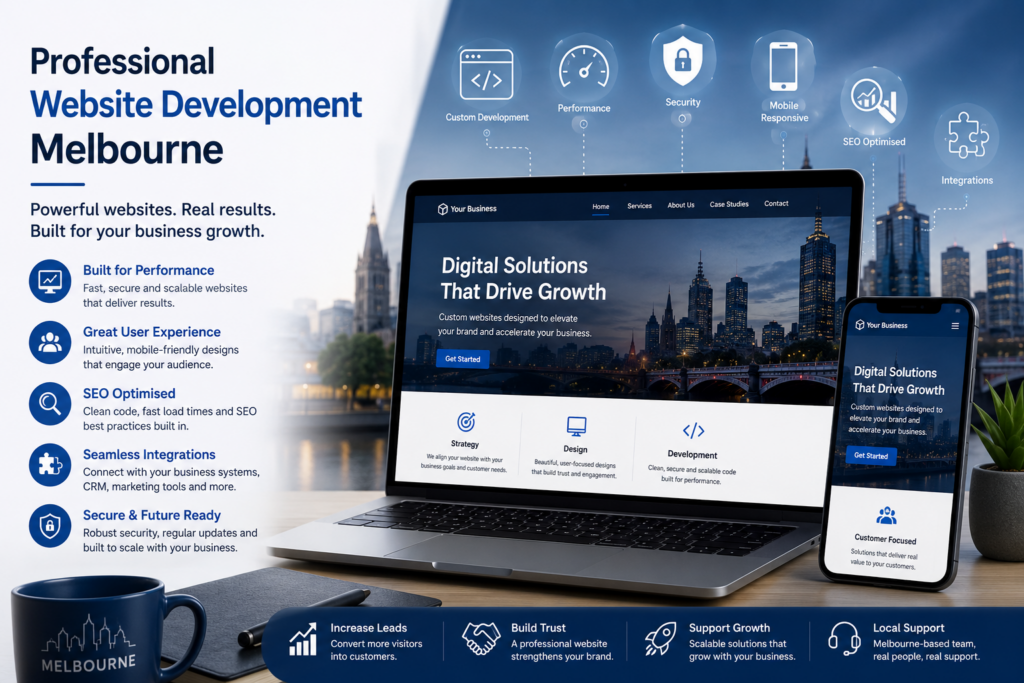





Your website is often the first point of contact between your business and a prospective client. Whether someone is evaluating a service, vetting a vendor, or simply trying to understand what your organisation does, the digital experience you offer shapes their impression before a conversation begins. Given that weight, the decision of which website development company in Melbourne you work with carries real commercial consequences and yet many businesses approach it without a clear framework for making that call well.
This guide outlines the criteria that matter, the questions worth asking, and the context Melbourne businesses need to make a confident, informed decision.
What to expect from good web development services in Melbourne
The talent pool is broad. Freelancers, offshore teams, boutique studios and full-service digital agencies all compete for the same briefs, and the pricing offered can look remarkably similar on paper. The differentiator is depth in technical capability, in strategic thinking and in the follow-through of a project once the contract is signed.
Begin with a portfolio review, but dig beneath the surface gloss. The best-in-class agencies build websites with scalable, future-proof code, they align development with business strategy rather than design alone, and they optimise for search visibility from the beginning. If a portfolio is replete with beautiful sites that give no evidence of performance thinking behind them, that is a meaningful signal.
Client testimonials and case studies are also important, but don’t just skim the text. What problem did the client have? What was built? What changed as a result? Generic testimonials tell you little. Documented outcomes tell you a great deal.
Pay attention, as well, to how the agency talks to you before you sign a contract. A reliable web development partner is a long-term collaborator, offering ongoing maintenance, security updates, and performance optimisations rather than simply a one-time project. If responsiveness and clarity are lacking in the sales process, they rarely improve once work is underway.
What services are included in Website Development?
This is a question many organisations don’t ask precisely enough, which leads to scope disagreements and budget surprises later. A professional engagement with quality web development services in Melbourne covers considerably more than design and code.
A full-service build might typically include discovery and strategy, information architecture, wireframing, visual design, front-end and back-end development, content migration and cross-device testing. Beyond the build, a well-scoped engagement should also include:
- CMS configuration: setup of a content management system that can be used by your team without ongoing technical support
- SEO foundations: URL structure, metadata, page speed, and indexability built into the site from day one instead of being retrofitted later
- Security and hosting architecture: This is especially important for organisations that manage customer data or are in regulated industries
- Analytics and tracking setup: to ensure the right events and goals are configured so you can measure performance accurately from day one
- Post-launch support: a defined process for fixing issues, making updates, and managing the site as needs change
Equally important to understand is what is not included. Most agencies will not write your content, will not guarantee you rankings, and will charge separately for changes outside of the agreed-upon scope. Understanding these constraints before the engagement begins avoids friction later.
What is the best platform for business websites in Melbourne?
One of the first questions a web development agency in Melbourne will ask is which platform to use, and the answer varies depending on the scale and needs of your business.
WordPress is an attractive option for SMEs, with simple to moderate content requirements, and little to no existing infrastructure to support a more technical implementation. There is a lot of talent and resources in the WordPress ecosystem; it is easy to learn, it’s the most popular, and the cost of entry is low. It’s well-suited to marketing sites, blogs, and sites with content that can be managed by a non-technical user.
Drupal has a steeper learning curve but is the better choice for enterprise-level organisations, government or other highly-regulated institutions, businesses with complex internal processes and data relationships, with advanced multilingual and content staging requirements, and organisations that place a premium on security and governance.
Custom Application Development comes into play when a business is looking to build digital products that are not easily contained within a traditional CMS, such as customer portals, booking systems, internal collaboration tools or SaaS products. A purpose-built application built from the ground up to match your specifications opens up new possibilities, but requires a bigger investment. The cost is higher, the build time is longer, but if your organisation is building a digital platform as the core mechanism to deliver your services, then that is an investment worth making.
How to evaluate custom application development proposals
Where bespoke development is a project requirement, the usual evaluation criteria are no longer applicable. The focus shifts from simply counting templates and plugins to evaluating the engineering depth, project management sophistication, and the team’s skill in turning business needs into working, sustainable code.
Ask the provider about how they respond to changes in requirements or scope, their testing/QA process, how they document and hand over code, and what kind of post-launch activities are on offer. If they struggle to answer, it is telling you something fundamental about how the project is likely to be run.
Also, be clear on ownership of intellectual property from the outset. All code, database structures and design assets created as part of the project should transfer outright to your organisation on completion, rather than remain licensed to the agency.
Making the final decision
Before making a decision, check portfolios for industry or feature relevant experience, technical skill sets against your roadmap, compare proposals against each other and with your shortlisted team’s current work in terms of timeline, deliverables and post-launch support, as well as assessing cultural fit, communication style and preferred project management approach.
Price is important, but it’s usually not the correct primary filter. A low quote with a vague scope, minimal post-launch support and no strategic input will almost inevitably end up costing more in the long run than a well-structured engagement with a competent team.
Organisations that get the most from their digital investment view the provider relationship as a partnership rather than a transaction, which starts by choosing a team that understands your business goals, not just your brief.