


Modernise your legacy systems without disrupting your business
Many organisations rely on legacy business systems that have supported their operations for years, sometimes decades. While these applications often continue to perform important functions, they can become increasingly difficult to maintain, expensive to support and challenging to integrate with modern platforms.
Microsoft Dynamics 365 provides a powerful foundation for digital transformation, but replacing every legacy system in a single project is rarely practical. That’s why many organisations choose a staged integration approach, allowing existing applications to continue operating while gradually introducing modern capabilities.
At Newpath, we help businesses bridge the gap between legacy applications and Dynamics 365. Our team designs secure, scalable integration solutions that preserve the value of your existing technology investments while enabling your organisation to move confidently towards a more connected, modern digital ecosystem.
Why legacy systems still matter
It’s easy to assume that older systems should simply be replaced, but in reality many legacy applications continue to perform critical business functions.
These systems often contain years of valuable business logic, historical data and operational processes that can’t simply be switched off overnight.
We regularly work with organisations that rely on:
- Custom-built business applications
- Older ERP systems
- On-premises databases
- SQL Server applications
- AS/400 and IBM i platforms
- Microsoft Access databases
- Finance and payroll systems
- Industry-specific software
- Manufacturing and warehouse management systems
- Document management platforms
The challenge isn’t that these systems still exist. The challenge is ensuring they can communicate effectively with newer platforms like Dynamics 365.
Avoid the risks of a complete replacement
Large-scale system replacements are often expensive, time consuming and high risk.
Attempting to replace every application simultaneously can result in lengthy implementation projects, significant business disruption and unforeseen technical challenges.
A phased integration strategy allows organisations to modernise at a pace that suits their business.
Instead of replacing everything at once, existing systems continue to operate while Dynamics 365 is introduced alongside them. Information is synchronised between platforms, allowing users to benefit from modern functionality without disrupting day-to-day operations.
This approach reduces project risk while providing a clear pathway towards long-term digital transformation.
Connecting old and new technologies
One of the biggest misconceptions about legacy systems is that they can’t integrate with modern cloud platforms.
In many cases, that’s simply not true.
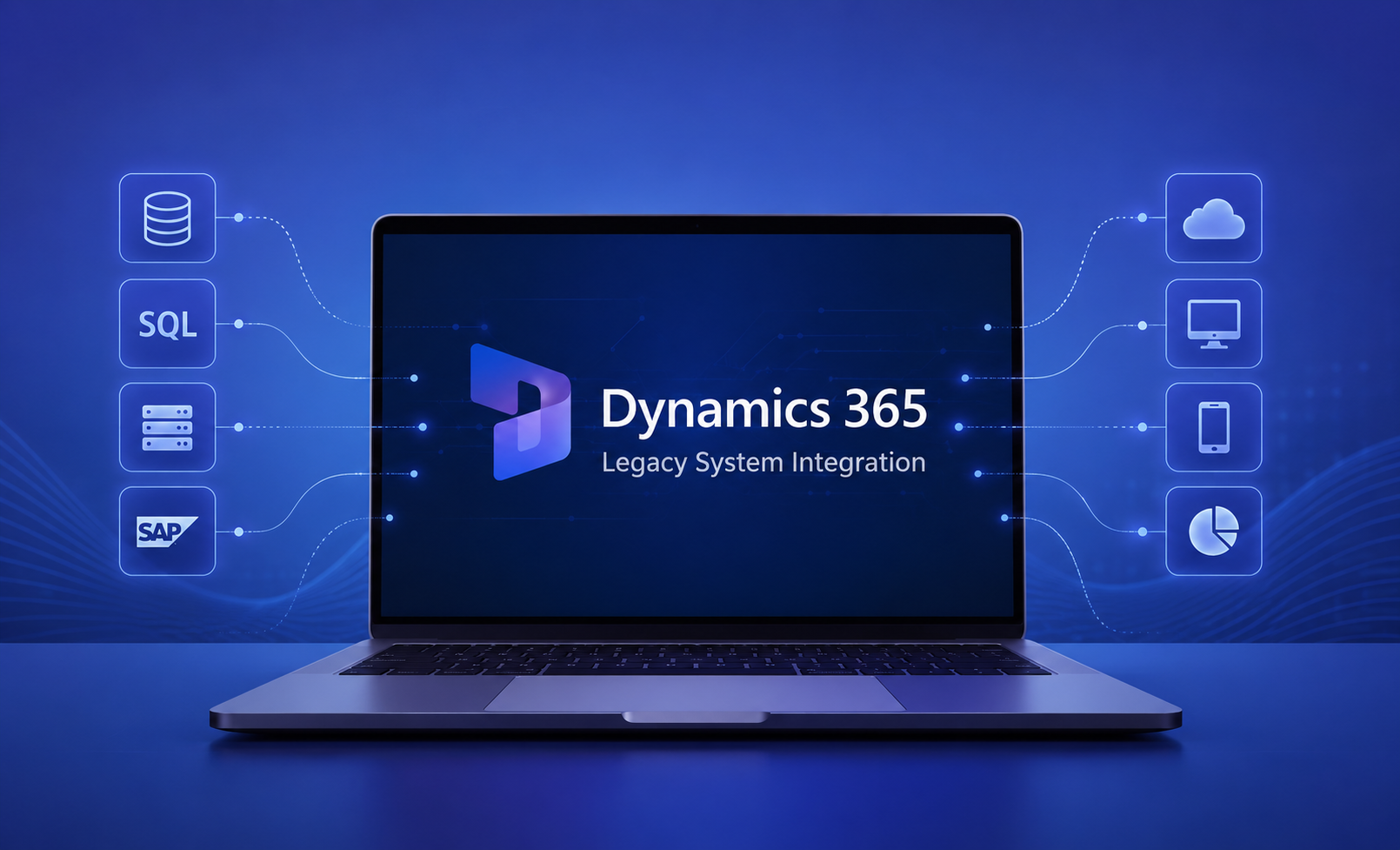
Our integration specialists have experience connecting Dynamics 365 with a wide range of older technologies using secure APIs, middleware, databases, scheduled synchronisation and modern integration services.
Depending on your environment, we may leverage:
- Microsoft Azure Integration Services
- REST APIs
- SOAP services
- SQL Server Integration Services (SSIS)
- Secure file transfers
- Power Automate
- Azure Functions
- Dataverse
- Custom integration components
The result is a connected environment where information flows between systems automatically, reducing manual effort and improving data consistency across the organisation.
Preserve your business knowledge
Legacy systems often contain years of accumulated business rules, workflows and specialised functionality that have evolved alongside your organisation.
Rather than discarding this knowledge, we help identify which processes should be retained, improved or replaced.
During every engagement we work closely with stakeholders to understand:
- How current systems are used
- Which business processes remain valuable
- Where manual work exists
- Opportunities for automation
- Future reporting requirements
- Compliance considerations
- Long-term technology objectives
This ensures your modernisation project delivers measurable business improvements rather than simply replacing one application with another.
Data migration done properly
For many organisations, the biggest concern during modernisation is their data.
Years of customer records, financial information, operational history and business documents represent one of the organisation’s most valuable assets.
Our team develops structured migration strategies that prioritise data quality, validation and business continuity.
This may involve:
- Data cleansing
- Duplicate removal
- Mapping legacy data structures
- Migration testing
- Validation and reconciliation
- Historical data archiving
- Incremental migration
- Rollback planning
The goal is not simply to move data, but to improve its quality and usability within Dynamics 365.
Preparing for future growth
Modernising legacy systems isn’t just about solving today’s problems.
It’s about building a technology platform capable of supporting future business growth.
By connecting legacy applications with Dynamics 365, organisations gain the flexibility to introduce new technologies over time, including:
- Microsoft Power Platform
- AI-powered automation
- Customer self-service portals
- Mobile applications
- Business intelligence dashboards
- Advanced reporting
- Workflow automation
- Cloud-native applications
Instead of another major replacement project in five years’ time, your technology environment becomes significantly easier to evolve.
Why choose Newpath?
At Newpath, we understand that every organisation has a unique technology landscape.
Our consultants combine enterprise software development expertise with deep experience across Microsoft technologies, enabling us to design practical modernisation strategies that minimise disruption while delivering meaningful business outcomes.
We don’t approach every project with the assumption that existing systems should be replaced.
Instead, we focus on helping organisations maximise the value of their current investments while creating a roadmap towards a more connected, scalable future.
Whether you’re integrating one legacy application or modernising an entire enterprise environment, our team works alongside you to deliver solutions that are technically sound, commercially practical and aligned with your long-term business objectives.
Frequently Asked Questions
Yes. Many legacy applications can be integrated with Dynamics 365 using APIs, middleware, databases or custom integration services. Every environment is different, which is why we begin with a technical assessment before recommending the most appropriate approach.
Not necessarily. In many cases, a phased integration strategy allows organisations to continue using existing systems while gradually transitioning to Dynamics 365.
Absolutely. We provide structured data migration services that include cleansing, validation, mapping, testing and reconciliation to ensure information is accurately transferred into Dynamics 365.
Project timeframes vary depending on the number of systems involved, the quality of existing data and the complexity of business processes. Following discovery, we’ll provide a detailed implementation roadmap.
Yes. We offer ongoing support, optimisation and enhancement services to ensure your integrated environment continues to evolve alongside your business.
You don’t need to replace every legacy system to begin your digital transformation journey.
Newpath can help you integrate existing applications with Microsoft Dynamics 365, creating a connected, scalable environment that supports your business today while preparing you for tomorrow.
Speak with our Microsoft specialists to discuss your legacy system integration requirements.
Contact Us