


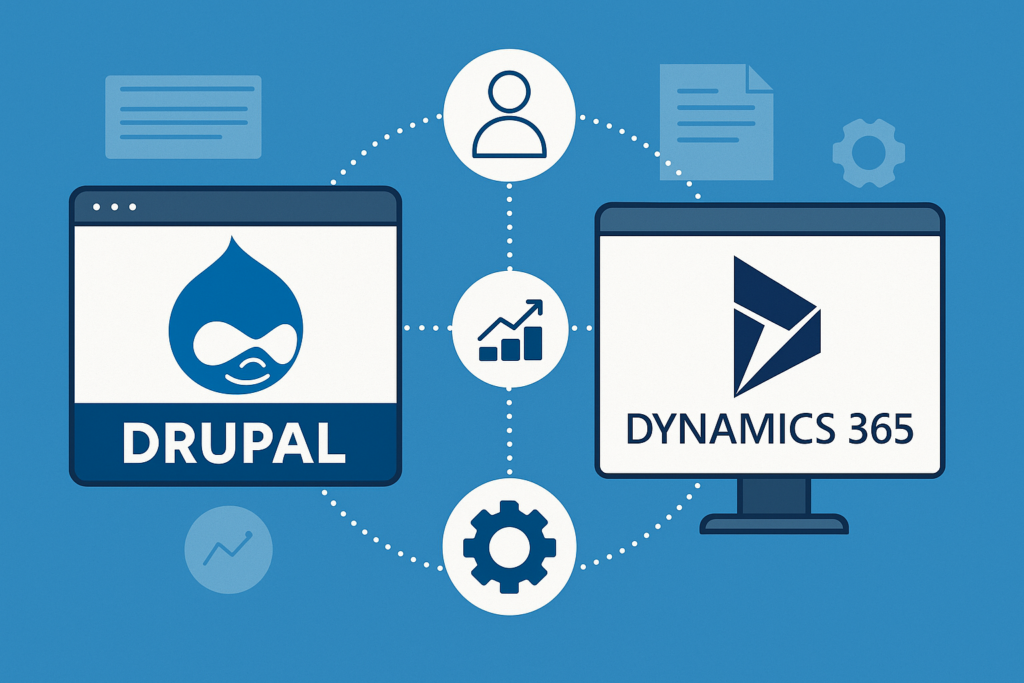

Digital transformation isn’t just about having the right platforms. It’s about connecting them. Many organisations today run world-class websites and digital experiences powered by Drupal, while managing customer, sales, and operational data in Microsoft Dynamics 365.
Both systems are leaders in their own right. But when they operate in isolation, they create one of the most common – and costly – gaps in modern business: the disconnect between experience and operations.
When your CMS and CRM don’t talk to each other, you end up with fragmented data, duplicated effort, and customers who get inconsistent experiences. The solution lies in integration. Connecting Drupal’s front-end power with Dynamics 365’s back-end intelligence.
1. The Experience–Operations Gap
In most organisations, the website is where customers engage first. They explore content, submit forms, make enquiries, or log in to their account.
Behind the scenes, those interactions should automatically feed into your CRM – creating or updating contact records, triggering notifications, and driving workflows.
But too often, that data sits disconnected. Marketing teams live in Drupal; sales and service teams operate in Dynamics 365. Information passes between systems through manual exports or emails, introducing delay, error, and missed opportunities.
This is what we call the Experience–Operations Gap – and it’s where integration has the biggest impact.
2. Why Integration Matters
Integrating Drupal with Dynamics 365 closes that gap and creates a single, connected ecosystem where every interaction is captured, understood, and acted upon.
Imagine a website enquiry automatically creating a new lead in D365 Sales. Or a logged-in member seeing their personalised account details, renewal status, and order history directly on your Drupal portal – all sourced live from Dynamics.
That’s the power of integration: real-time data flow, intelligent automation, and consistency across every channel.
The benefits are tangible:
-
Personalisation at scale: Tailor content and recommendations based on CRM data – interests, segments, or lifecycle stage.
-
Improved accuracy: Eliminate manual data entry and duplication across systems.
-
Faster response times: Leads and support tickets route instantly to the right team.
-
Operational efficiency: Automate repetitive admin, freeing teams to focus on value.
-
360° customer view: Every department works from the same, up-to-date information.
3. What Integration Looks Like in Practice
A Drupal–Dynamics 365 integration can be achieved in several ways, depending on your systems and objectives.
At Newpath, we typically integrate via Microsoft Azure services – such as Logic Apps, Service Bus or API Management – or via direct API connections between Drupal and D365.
Here’s what the architecture often looks like:
-
Drupal manages all front-end content, forms, and user authentication.
-
Dynamics 365 handles CRM, membership, finance, and workflow automation.
-
Azure acts as the secure bridge, synchronising and transforming data in real time.
Common integration points include:
-
Contact and lead data sync between website forms and D365
-
User authentication (Drupal login with D365 credentials or Azure AD)
-
Customer portals showing live CRM data (accounts, invoices, cases, orders)
-
Event registration and payment details automatically logged in D365
-
Marketing list synchronisation for targeted campaigns
-
Support ticket creation from website interactions
This approach delivers both flexibility and control – allowing data to flow intelligently between systems without compromising security or performance.
4. Beyond Efficiency: Building Smarter Experiences
The impact of integration goes far beyond time savings. It enables businesses to deliver experiences that feel connected, responsive and intelligent.
-
For customers, it means consistency: the same information wherever they interact.
-
For staff, it means better visibility: fewer blind spots between marketing, sales and service.
-
For leaders, it means real-time insights: from campaign performance to customer satisfaction.
With Drupal and Dynamics working together, businesses can finally achieve what so many digital strategies promise: a unified, data-driven customer experience.
5. Real-World Applications
Newpath has implemented Drupal–Dynamics integrations across industries including Health, Construction, Supply Chain, Education, and Government, each with unique challenges and measurable results.
-
In Health, integrations have powered secure patient and member portals, where clinical and membership data flow seamlessly between web and CRM.
-
In Construction, integrations enable real-time contractor management, project updates, and compliance tracking.
-
In Supply Chain, data sync between websites, CRMs and logistics systems drives predictive insights and operational automation.
-
In Education, students can enrol, update details, and access personalised dashboards, all linked directly to D365.
Each use case shares the same foundation: reduced manual effort, improved data accuracy, and a smoother digital experience.
6. Making It Future-Ready
Technology moves fast – but a well-designed integration keeps you ahead.
By leveraging Microsoft’s Power Platform, Azure infrastructure and Drupal’s open APIs, organisations can extend their integrations into advanced automation, AI, and analytics.
Future-ready integrations include:
-
Power Automate flows for triggered communications or approvals
-
AI-driven chatbots linked to Dynamics data
-
Predictive analytics dashboards combining CRM and website data
-
Data warehouse or BI integrations for deeper insights
The goal isn’t just connectivity – it’s intelligence at scale.
7. The Newpath Difference
Integrating Drupal and Dynamics 365 requires deep understanding of both ecosystems — and that’s where experience counts.
Newpath brings a multidisciplinary team across digital experience, CRM, integration architecture and cloud engineering. We design, implement and support end-to-end integrations that are robust, secure, and scalable.
Our approach combines:
-
Platform expertise: Drupal, D365, Azure, Power Platform, custom APIs
-
Business understanding: Mapping data flow to actual processes and outcomes
-
Agile delivery: Rapid prototyping and continuous optimisation
-
Security and compliance: Data protection aligned with industry standards
The result? A seamless connection between the systems that power your business and the experiences that grow it.
8. The Takeaway
Drupal delivers rich, flexible content experiences.
Dynamics 365 delivers operational intelligence and customer visibility.
When the two are connected, your business gains a single, cohesive digital engine. One that unites marketing, operations, and customer engagement under one source of truth.
For organisations ready to modernise their digital ecosystem, a Drupal–Dynamics 365 integration isn’t just an upgrade. It’s a transformation.