


At Newpath, we’ve always believed that the best digital work sits at the intersection of technology, clarity, and real-world impact.
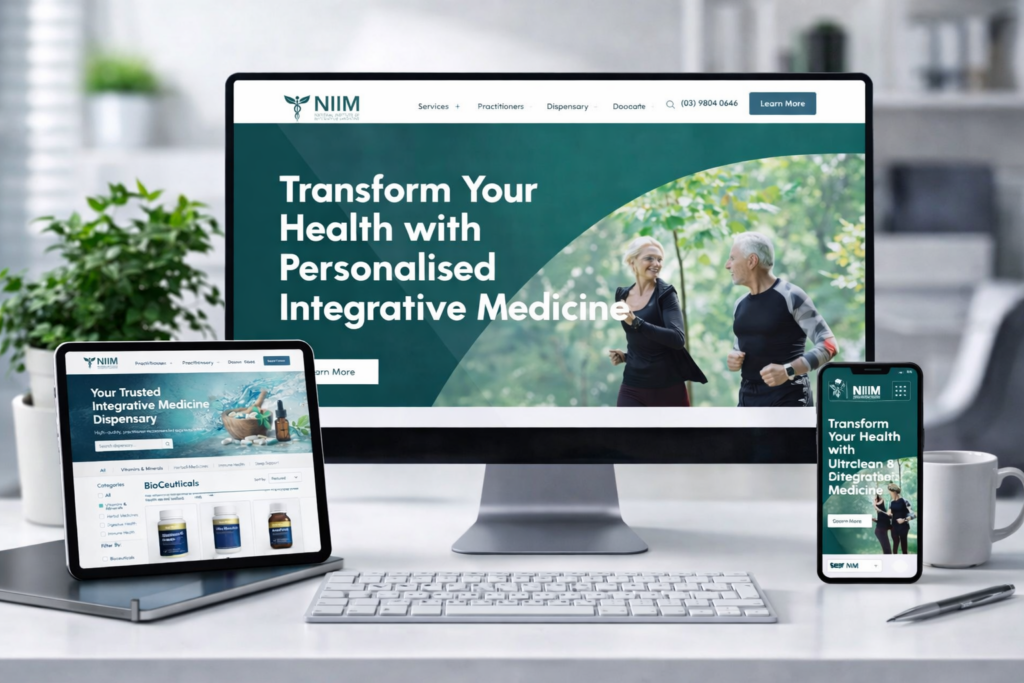
The recent launch of the new NIIM website is a reflection of that belief.
This project wasn’t driven by commercial objectives. It came through our social responsibility program, where we partner with organisations doing meaningful work in the community and support them through pro bono delivery. In this case, it started with a conversation with Radek Sali, who is closely involved in NIIM, (and a mate of our CEO, Nathan Sinnott), and its mission to support people living with chronic disease or in need of functional medical practitioners.
From that initial discussion, it was clear there was an opportunity to do more than just refresh a website. What NIIM needed was a complete rethink of how its digital presence supported its broader purpose.
Moving beyond a traditional website
Healthcare organisations face a unique challenge when it comes to digital.
They are not simply communicating services. They are supporting people who are often navigating complex, ongoing health conditions. That requires a very different level of clarity, accessibility, and trust.
The existing NIIM digital experience did not fully reflect the depth or quality of the organisation’s offering. Information was fragmented, pathways were unclear, and the overall user journey made it difficult for patients to understand how to engage with the clinic and its services.
This is a common issue in healthcare.
Organisations invest heavily in clinical capability, but their digital environments lag behind, creating a disconnect between the quality of care and the way that care is accessed.
Our approach was to treat this not as a website rebuild, but as a platform redesign.
Designing for clarity in complex environments
One of the primary objectives was to simplify the experience without oversimplifying the content.
NIIM offers a broad range of services, spanning integrative medicine, allied health, and specialised treatment pathways. For a new patient, particularly one dealing with chronic disease, this can quickly become overwhelming.
The UX strategy focused on creating clear, structured pathways that guide users based on their needs, rather than forcing them to navigate the organisation’s internal structure.
This meant:
- Reworking the information architecture to align with patient journeys
- Creating intuitive entry points for different types of care
- Reducing cognitive load through simplified navigation and content hierarchy
The goal was simple. When someone lands on the site, they should immediately understand where they are, what NIIM offers, and how to take the next step.
That clarity is critical in healthcare, where uncertainty can act as a barrier to engagement.
Elevating the user interface
From a UI perspective, the design needed to balance professionalism with approachability.
Healthcare environments can often feel clinical or transactional. For NIIM, the intention was to create something that felt more human. Calm, structured, and reassuring.
The visual language was designed to support this.
Clean layouts, generous spacing, and a restrained colour palette work together to create a sense of clarity and focus. Typography is used deliberately to guide users through content, ensuring that key information stands out without overwhelming the page.
Importantly, the interface is not decorative. Every design decision supports usability.
Forms are simplified. Key actions are clearly defined. Content is structured in a way that allows users to scan quickly and find what they need without friction.
This is where good UI moves beyond aesthetics and becomes a functional tool for engagement.
Building a connected digital experience
A major component of the project was ensuring that the website operated as part of a broader digital ecosystem, rather than as a standalone asset.
In many organisations, websites exist in isolation. They generate enquiries, but those enquiries are not always captured or managed effectively. There is limited visibility of the full patient journey.
For NIIM, we focused on creating a more connected experience.
Enquiry pathways were streamlined. Booking flows were clarified. Key interactions were structured in a way that supports both the user and the organisation.
This creates a more consistent experience for patients, while also enabling better internal visibility and follow-up.
Introducing a fully integrated dispensary
One of the most significant additions to the NIIM platform is the new online dispensary.
This is not a simple eCommerce layer. It is a fully integrated extension of the clinic’s service offering, designed to support patients beyond their initial consultation.
The dispensary provides access to practitioner-prescribed supplements and medicines through a structured, secure online environment. From a user perspective, it needed to be seamless. From a compliance perspective, it needed to be robust.
We designed and built a tailored eCommerce experience that aligns with the clinical model.
This included:
- A clean and intuitive product browsing experience
- Structured categorisation aligned with treatment pathways
- Secure access to practitioner-recommended products
- A simplified purchasing process that reduces friction while maintaining integrity
The result is a platform that supports continuity of care.
Patients are not left to source products independently. Instead, they can access trusted, practitioner-backed solutions directly through the NIIM ecosystem.
From a digital perspective, this represents a shift from a static website to a functional healthcare platform.
Performance, scalability, and future readiness
While much of the focus in projects like this sits on UX and UI, the underlying architecture is equally important.
The platform has been built with scalability in mind.
As NIIM continues to evolve its services, the website needs to support that growth without requiring constant redevelopment. Content structures, templates, and components have been designed to be flexible, allowing the team to expand and adapt over time.
Performance was also a key consideration.
Healthcare users expect fast, responsive experiences, particularly on mobile devices. The platform has been optimised to ensure that pages load quickly and interactions feel smooth across all devices.
This is not just a technical detail. It directly impacts engagement and conversion.
A different way of thinking about digital in healthcare
Projects like this highlight a broader shift in how digital should be approached in healthcare and similar sectors.
It is no longer sufficient to have an online presence.
Digital platforms are becoming central to how services are delivered, accessed, and experienced. They are no longer a layer on top of the organisation. They are part of the organisation.
For NIIM, this project represents a step in that direction.
It brings together content, user experience, and functionality into a cohesive platform that better supports both patients and practitioners.
More than a project
From our perspective, this was more than a standard delivery.
It was an opportunity to apply our capability in a context that has real impact. To help an organisation that is doing important work reach and support more people in a meaningful way.
That is ultimately what good digital work should do.
Not just look better. Not just function better. But create better outcomes.
Closing thoughts
The new NIIM platform reflects what is possible when technology, design, and purpose are aligned.
It simplifies complexity. It improves access. It creates a clearer pathway for patients to engage with care.
And importantly, it establishes a foundation for ongoing evolution.
Because in environments like healthcare, digital transformation is not a one-off project. It is an ongoing capability.
We’re proud to have played a role in that journey.