




Search is changing, and most businesses haven’t caught up.
For years, digital strategy has been built around one core assumption: people search using text. Keywords, phrases, and queries have driven everything from SEO strategies to content planning and website architecture.
That assumption is now breaking down.
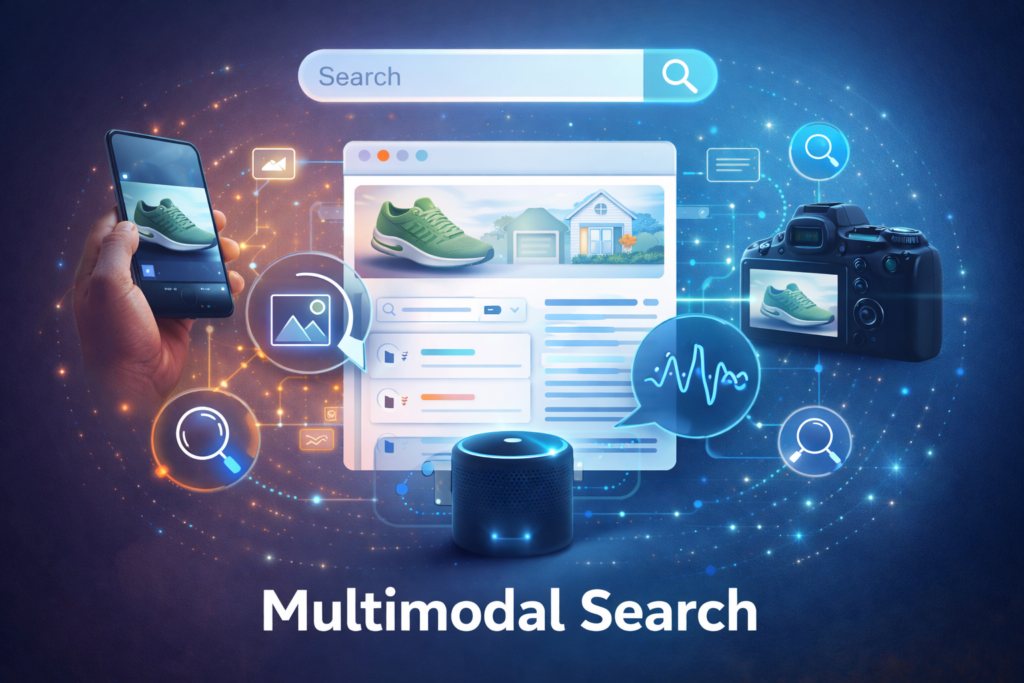
We are entering the era of multimodal search, where users no longer rely on text alone. They search using images, voice, video, and increasingly, combinations of all three. A photo, paired with a question. A voice query, supported by visual context. A screenshot, used as the starting point for discovery.
This shift is not incremental. It fundamentally changes how people find information, and more importantly, how they decide.
For organisations that rely on digital channels to drive engagement, leads, and revenue, this is a moment that requires attention.
What is multimodal search?
At its core, multimodal search refers to the ability to search using multiple types of input at once.
Instead of typing a query like “modern outdoor landscaping ideas”, a user might:
- upload a photo of their backyard
- ask a voice-based question about improving it
- refine results by selecting visual options
Search engines and AI platforms now process all of these inputs together, not in isolation.
This is already being driven by platforms like Google Lens, ChatGPT, Gemini, and other AI-powered tools that combine visual understanding with natural language processing.
The result is a richer, more intuitive search experience.
But it also raises the bar significantly for businesses.
The shift from keywords to context
Traditional search has always been about keywords.
You optimise for specific terms. You structure content around search intent. You rank based on relevance and authority.
Multimodal search shifts the focus from keywords to context.
An image is no longer just a supporting asset. It becomes a primary input. A product photo, a design, a diagram, or even a screenshot can now drive discovery.
AI systems analyse:
- visual elements within the image
- relationships between objects
- contextual meaning
- accompanying text or voice input
This means that content is no longer evaluated purely on what it says, but also on what it shows.
For businesses, this creates both a challenge and an opportunity.
Why this matters for your business
Most websites today are not designed for this reality.
They are built for text-based discovery. Images are often treated as secondary. Video is used sparingly. Structured data is inconsistent.
In a multimodal world, this creates a visibility gap.
If your competitors are producing rich, well-structured visual content, supported by clear context, they will be more discoverable across emerging search experiences.
This is particularly relevant in industries where visual context plays a role in decision-making.
A landscaping company that showcases high-quality project imagery, paired with clear descriptions, becomes more searchable through image-based queries.
A healthcare provider that uses diagrams, explainer videos, and structured content can better support patients navigating complex topics.
An eCommerce business with detailed product imagery, multiple angles, and contextual usage scenarios will outperform one that relies on basic product listings.
Multimodal search rewards completeness.
The role of AI in shaping search behaviour
AI is accelerating this shift at a rapid pace.
Platforms like ChatGPT and Gemini are not just returning links. They are synthesising information, interpreting inputs, and providing direct answers.
When combined with multimodal capabilities, this becomes even more powerful.
A user might upload an image of a product and ask:
“What is this and where can I buy it?”
The AI system can:
- identify the object
- provide contextual information
- suggest similar products
- link to relevant sources
This reduces the need for traditional search journeys.
Instead of moving from query to results to website, users are getting closer to answers immediately.
For businesses, this means that visibility is no longer just about ranking on a search results page. It’s about being part of the answer.
Rethinking your content strategy
To remain competitive, organisations need to rethink how they approach content.
This starts with recognising that content is no longer just written.
It is:
- visual
- interactive
- structured
- contextual
A strong multimodal content strategy includes:
Clear, descriptive imagery
Images should not just look good. They should be purposeful. Show context, usage, and detail. Avoid generic stock imagery where possible.
Video as a primary asset
Short, clear videos explaining products, services, or concepts are increasingly important. These provide both visual and contextual signals to search systems.
Structured data and metadata
Content needs to be machine-readable. This includes alt text, captions, schema markup, and consistent naming conventions.
Integrated storytelling
Text, images, and video should work together. A page should not rely on one format alone.
This is not about producing more content. It is about producing better, more complete content.
The importance of user experience
Multimodal search does not stop at discovery. It extends into the experience users have once they land on your platform.
If a user arrives from an image-based search, they expect to see what they searched for immediately. If they come from a video or AI-generated answer, they expect continuity.
This places greater importance on:
- page structure
- content hierarchy
- clarity of messaging
- speed and performance
If the experience does not align with the expectation set by the search interaction, users will leave.
This is where UX becomes a critical part of search strategy.
Practical steps to get started
For many organisations, the idea of adapting to multimodal search can feel abstract.
The reality is that most of the work sits in improving fundamentals.
Start with your existing content.
Review your website and ask:
- Are images meaningful or decorative?
- Do they provide context and value?
- Is there a balance between text, visual, and video content?
- Is content structured in a way that both users and machines can understand?
From there, focus on key areas of impact.
Prioritise high-value pages
Product pages, service pages, and key landing pages should be the first to evolve.
Enhance visual content
Replace generic imagery with real, relevant visuals. Show your work, your process, and your outcomes.
Add context to everything
Every image, video, and piece of content should be supported by clear descriptions.
Think in journeys, not pages
How does a user move from discovery to decision? Ensure that each step is supported.
The competitive advantage
The organisations that move early in this space will have a clear advantage.
Multimodal search is still evolving. Standards are still forming. Most businesses have not yet adapted.
This creates an opportunity to stand out.
By investing in richer, more connected content now, organisations can position themselves to be more visible, more relevant, and more valuable in emerging search environments.
Closing perspective
Search is no longer just about what people type.
It is about what they see, what they say, and how they interact.
Multimodal search represents a shift toward more natural, human ways of finding information. It removes friction. It reduces effort. It brings users closer to answers.
For businesses, this changes the rules.
The question is no longer “how do we rank for this keyword?”
It is “how do we become part of the answer, regardless of how the question is asked?”
Those that can answer that effectively will define the next phase of digital visibility.
And those that don’t will find themselves increasingly difficult to find.