



For enterprise organisations, a website is rarely just a website.
It can be a critical digital platform supporting customers, employees, partners, investors and other stakeholders across multiple countries, brands, languages and business units. It may need to integrate with CRM platforms, identity systems, product databases, marketing technology, search platforms, analytics tools and numerous internal applications.
It also needs to remain secure, accessible, scalable and manageable over many years.
This is where Drupal has established itself as one of the world’s leading enterprise content management platforms.
But what exactly is Drupal, how does it differ from other content management systems, and why do large organisations choose it?
This guide explains what Drupal is, how it works and where it fits within a modern enterprise digital strategy.
What is Drupal?
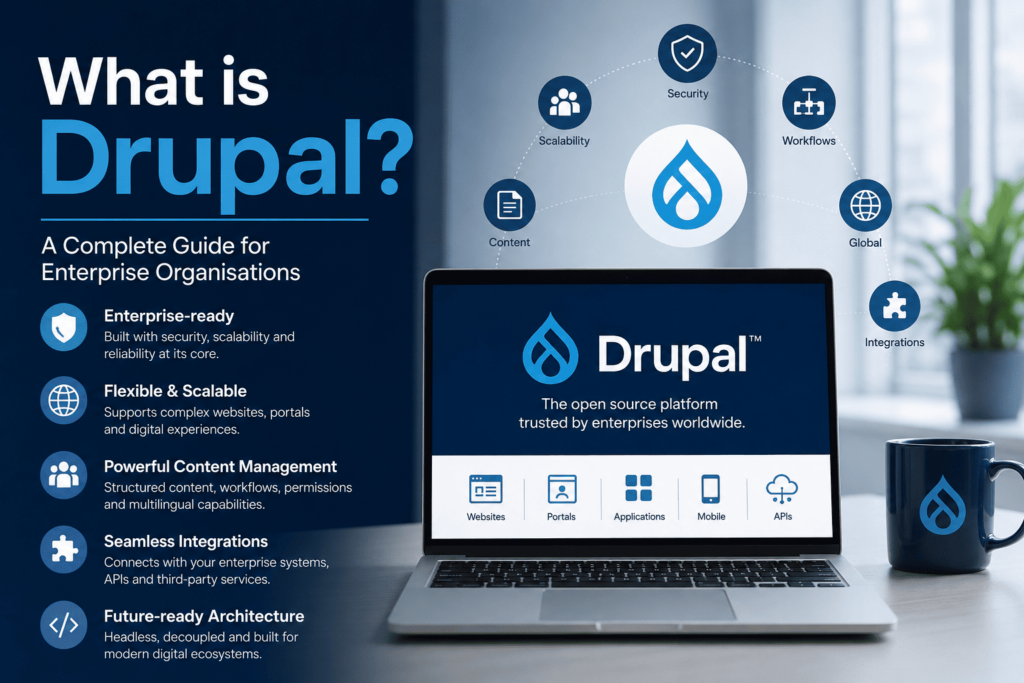
Drupal is an open-source content management system (CMS) and digital experience platform framework used to build and manage websites, portals, applications and complex digital ecosystems.
Written primarily in PHP and built on modern web development standards, Drupal provides organisations with a highly configurable foundation for managing content, users, workflows, integrations and digital experiences.
At its simplest, Drupal allows authorised users to create and manage website content without needing to write code.
At an enterprise level, however, Drupal can do considerably more.
It can become the central content and application layer behind:
- Corporate websites
- Multi-country and multilingual websites
- Customer and partner portals
- Government and public-sector platforms
- Intranets
- Product and service platforms
- Membership websites
- Headless and decoupled applications
- Mobile applications
- Complex multi-site environments
This flexibility is one of the key differences between Drupal and many more traditional CMS platforms.
Rather than forcing an organisation into a predetermined website structure, Drupal provides a framework from which highly customised digital platforms can be engineered.
Is Drupal open source?
Yes.
Drupal is released as open-source software, meaning its source code is publicly available and developed through a global community of developers, agencies and technology organisations.
This provides several advantages for enterprise organisations.
There are no proprietary CMS licence fees simply for using Drupal, and organisations are not locked into a single software vendor to maintain or develop their platform.
An organisation can change Drupal development partners, establish an internal development team or use multiple specialist providers.
Open source should not, however, be confused with “free to operate”.
Enterprise Drupal environments still require professional architecture, development, hosting, monitoring, security, maintenance and support.
The difference is that investment is generally directed towards the implementation and operation of the digital platform, rather than paying a vendor purely for permission to use the underlying CMS.
Why do enterprise organisations use Drupal?
Drupal’s strength becomes particularly apparent when digital requirements become complex.
A relatively simple marketing website might be achievable using almost any modern CMS. Enterprise platforms introduce a very different set of requirements.
An organisation might operate 20 websites across 12 countries, publish content in multiple languages, integrate with several internal platforms, require sophisticated publishing approvals and maintain strict accessibility and security standards.
Drupal has been designed to accommodate this type of complexity.
-
Structured content management
One of Drupal’s greatest strengths is its approach to structured content.
Rather than treating every webpage as essentially a block of formatted text, Drupal allows organisations to define sophisticated content models.
For example, a product could contain structured fields for:
- Product name
- Category
- Description
- Specifications
- Technical documentation
- Images
- Videos
- Certifications
- Related products
- Markets
- Languages
That information can then be displayed differently depending on the website, application, country or digital channel requesting it.
This becomes extremely powerful when organisations manage thousands of pieces of content across multiple digital properties.
-
Enterprise-grade content governance
Large organisations rarely want every content editor to have unrestricted publishing access.
Content may need to move through defined workflows involving authors, reviewers, legal teams, marketing departments or business-unit managers before publication.
Drupal provides sophisticated capabilities around:
Roles and permissions
Different users can be granted highly granular permissions determining exactly what they can create, edit, approve, publish or administer.
Editorial workflows
Content can move through states such as:
Draft → Review → Approved → Published → Archived
These workflows can be adapted to organisational governance requirements.
Content moderation
Drupal can maintain unpublished revisions while the currently approved version remains publicly available.
This allows teams to prepare changes without immediately altering production content.
For regulated organisations, government departments and large corporate environments, these governance capabilities can be extremely important.
-
Multi-site capabilities
Enterprise organisations frequently operate more than one website.
There may be different websites for countries, brands, subsidiaries, products or audiences.
Without an appropriate architecture, these environments can gradually become dozens of independent websites, each requiring separate upgrades, security management and development.
Drupal can support sophisticated multi-site and multi-domain architectures where organisations share components, design systems, functionality or infrastructure across multiple websites.
For example, an organisation could operate:
- australia.example.com
- newzealand.example.com
- singapore.example.com
- examplebrand.com
while maintaining common technology and governance standards.
The exact architecture should always be determined by the organisation’s requirements, but Drupal provides considerable flexibility for creating these models.
-
Multilingual and international websites
International organisations face another challenge: language.
Drupal provides extensive multilingual capabilities within its core platform.
Content, menus, interfaces, taxonomy and configuration can be translated and managed across different languages.
This allows organisations to create sophisticated localisation models where content can be:
- Globally shared
- Regionally controlled
- Locally translated
- Country-specific
- Language-specific
For global organisations, this can dramatically simplify the management of large international digital estates.
-
Security
Security is one of the most important considerations when selecting an enterprise CMS.
Drupal maintains a dedicated security team responsible for coordinating the investigation and disclosure of security vulnerabilities affecting Drupal core and contributed projects.
Security advisories and patches are published through established processes, allowing organisations and their technology partners to respond appropriately.
Drupal also supports enterprise security practices including:
- Granular access controls
- Role-based permissions
- Secure authentication architectures
- Configuration management
- Audit and logging capabilities
- Integration with enterprise identity providers
- Security-focused deployment workflows
Importantly, however, using Drupal does not automatically make a website secure.
Security ultimately depends on the entire technology environment: application architecture, hosting, configuration, patch management, custom code, third-party integrations, access controls, monitoring and operational processes.
For enterprise environments, Drupal should therefore form part of a broader security architecture rather than being considered a security solution by itself.
-
Integration with enterprise systems
Modern websites rarely operate independently.
An enterprise digital platform may need to communicate with:
- Salesforce
- Microsoft Dynamics
- SAP
- ERP systems
- Product Information Management (PIM) platforms
- Digital Asset Management (DAM) systems
- Marketing automation platforms
- Identity providers
- Payment gateways
- Search platforms
- Analytics systems
- Internal APIs
- Data warehouses
Drupal is particularly well suited to integration-driven environments.
Its API capabilities and extensible architecture allow Drupal to operate as one component within a much larger enterprise technology ecosystem.
For organisations undertaking digital transformation, this is often far more important than simply having an easy-to-use page editor.
-
Headless and decoupled Drupal
Drupal does not necessarily need to control the presentation layer of a website.
In a traditional Drupal implementation, Drupal manages both content and the website interface.
In a headless or decoupled architecture, Drupal can instead operate primarily as the content and application backend.
Content can then be delivered through APIs to technologies such as React or Next.js, mobile applications, digital displays or other systems.
A single piece of Drupal-managed content could potentially be distributed to:
Drupal → Corporate website
Drupal → Mobile application
Drupal → Customer portal
Drupal → Digital display
Drupal → Third-party application
This supports the concept of create once, publish everywhere, although achieving this effectively requires careful content modelling and architecture.
Is Drupal difficult for content editors?
This is one of the most persistent misconceptions surrounding Drupal.
Historically, Drupal developed a reputation for having an administration experience primarily suited to technical users.
Modern Drupal is considerably different.
A professionally designed Drupal implementation can provide content editors with:
- Visual editing tools
- Media libraries
- Reusable components
- Structured page-building interfaces
- Drag-and-drop functionality
- Content previews
- Editorial workflows
- Revision history
- Responsive administration interfaces
The important distinction is that Drupal’s editing experience is highly configurable.
A poorly designed implementation can certainly feel complicated. A well-designed enterprise implementation should hide unnecessary technical complexity from content teams and expose only the tools relevant to their role.
The CMS experience should therefore be considered part of the UX design process rather than simply accepting the default administration interface.
Drupal vs WordPress
Drupal and WordPress are frequently compared, but they often serve different requirements.
WordPress is an excellent platform and powers an enormous proportion of the web. It can be particularly effective for marketing websites, publishing platforms and organisations requiring relatively straightforward content management.
Drupal tends to become more attractive as complexity increases.
For example:
| Requirement | WordPress | Drupal |
| Simple marketing website | Excellent | Excellent |
| Blogging/publishing | Excellent | Excellent |
| Complex structured content | Good | Excellent |
| Granular permissions | Good | Excellent |
| Complex editorial workflows | Plugin/customisation dependent | Strong native capabilities |
| Multi-site enterprise architecture | Available | Highly flexible |
| Multilingual environments | Often extension dependent | Strong core capabilities |
| Complex enterprise integrations | Possible | Particularly well suited |
| Headless architecture | Available | Strong API-first capabilities |
| Highly customised applications | Possible | Highly flexible |
The question therefore shouldn’t necessarily be:
“Is Drupal better than WordPress?”
A better question is:
“Which platform is most appropriate for our requirements, complexity, risk profile and long-term digital strategy?”
For many straightforward websites, Drupal may be more platform than an organisation needs.
For complex enterprise ecosystems, however, that additional capability can become precisely the reason for choosing it.
Drupal and accessibility
Accessibility is another major consideration for enterprise and government organisations.
Drupal provides a strong technical foundation for creating accessible websites and supports modern semantic web standards.
However, just like security, accessibility cannot be guaranteed simply by choosing a particular CMS.
Achieving standards such as WCAG 2.2 AA requires accessibility to be considered throughout:
- UX and interface design
- Front-end development
- Component development
- Content creation
- Testing
- Quality assurance
- Ongoing governance
Drupal can provide the foundation, but accessibility must remain an organisational and development discipline.
Drupal’s role in modern digital architecture
Perhaps the most useful way for enterprise organisations to think about Drupal is not simply as a CMS.
It can instead be viewed as a content and digital experience layer within a broader enterprise architecture.
For example:
Users
↓
Websites / Apps / Portals
↓
Drupal Content & Experience Layer
↓
APIs & Integration Services
↓
CRM / ERP / PIM / DAM / Identity / Marketing Platforms
This architecture allows organisations to separate different responsibilities while enabling Drupal to manage the content, workflows and experiences it is particularly good at managing.
It also creates opportunities to progressively modernise individual components without necessarily rebuilding the entire digital ecosystem.
Is Drupal right for your organisation?
Drupal is particularly worth considering where an organisation has:
- Multiple websites, brands or countries
- Complex content structures
- Large content volumes
- Multiple languages
- Sophisticated editorial workflows
- Strict permissions or governance requirements
- Significant security requirements
- Enterprise system integrations
- Customer or partner portals
- Accessibility requirements
- Headless or omnichannel ambitions
- Long-term requirements for platform extensibility
Conversely, a small organisation requiring a relatively simple five-page marketing website may not need the architectural capabilities Drupal provides.
Platform selection should always begin with requirements rather than technology preference.
The importance of Drupal architecture
There is also an important caveat.
Drupal is extremely flexible, but flexibility creates architectural choices.
Two Drupal websites can be implemented very differently.
A successful enterprise Drupal implementation requires decisions around:
- Content architecture
- Component architecture
- Integration patterns
- Hosting infrastructure
- Security
- Caching and performance
- Search
- Deployment pipelines
- Configuration management
- Multi-site strategy
- Governance
- Accessibility
- Monitoring
- Disaster recovery
- Ongoing maintenance
This is why enterprise Drupal projects should generally begin with a structured discovery, business analysis, UX and technical architecture phase rather than moving immediately into development.
The objective should not simply be to build the website required today.
It should be to create a digital platform capable of supporting what the organisation will require tomorrow.
The future of Drupal
The role of the enterprise CMS is continuing to evolve.
Organisations increasingly need to distribute content across websites, applications, portals and emerging AI-driven interfaces while integrating with growing numbers of enterprise platforms.
At the same time, organisations are demanding greater control over security, accessibility, data, governance and digital infrastructure.
Drupal’s open-source model, structured content architecture, API capabilities and extensibility position it well within this changing environment.
Rather than functioning purely as a traditional website CMS, Drupal can form part of a broader composable digital architecture, providing the structured content and governance layer that connects people, systems and digital channels.
Final thoughts
So, what is Drupal?
At its simplest, Drupal is an open-source content management system.
For enterprise organisations, however, that definition significantly understates what the platform can provide.
Drupal can become the foundation for complex digital ecosystems incorporating multiple websites, languages, applications, integrations, workflows and audiences.
Its major strength is not that it makes simple websites easier to build.
Its strength is that it provides organisations with the flexibility to manage complex digital requirements without necessarily being constrained by the CMS itself.
That makes Drupal particularly relevant to organisations whose websites have evolved beyond marketing channels and become important pieces of enterprise infrastructure.
The key question when evaluating Drupal therefore isn’t simply whether it can build your next website.
It is whether your organisation needs a digital platform capable of supporting its broader digital ecosystem for the next five, ten or more years.
For organisations dealing with scale, complexity, integration, governance and long-term digital transformation, Drupal remains one of the strongest platforms available.