



Most enterprise organisations don’t have a website problem.
They have a platform problem.
Over time, digital estates grow in ways that make sense in the moment. A new region launches and selects a platform based on immediate needs. A business unit engages a different agency. A campaign requires speed, so a separate solution is introduced. Each decision is reasonable in isolation.
The issue is what happens over time.
What emerges is a fragmented environment made up of multiple platforms, vendors and disconnected experiences. Different regions operate differently. Content is duplicated. Governance becomes inconsistent. Costs increase, but often without clear visibility.
At this point, the problem shifts from marketing to technology leadership.
CIOs are no longer asking how to improve individual websites. They are asking how to rationalise and control a digital ecosystem that has become complex, expensive and difficult to manage.
This is where the concept of a digital platform becomes critical.
A platform is not just a website. It is a structured, governed and scalable foundation that supports multiple sites, regions and business units within a single architecture.
The hidden cost of fragmentation
In many organisations, fragmentation is not immediately obvious.
Each site may appear functional. Each team may feel in control of their own environment. However, when viewed at an enterprise level, inefficiencies begin to surface.
Teams duplicate effort by solving the same problems multiple times. Content is recreated rather than reused. User experience varies across regions. Reporting lacks consistency. Vendor management becomes unnecessarily complex.
These issues compound over time.
The cost is not just financial. It impacts speed, governance and the organisation’s ability to evolve. When every change requires coordination across multiple systems and stakeholders, progress slows. When governance is inconsistent, risk increases. When systems are disconnected, opportunities for integration are missed.
This is why many CIOs are prioritising consolidation.
Why Drupal aligns with enterprise platform strategy
Drupal is increasingly being adopted in enterprise environments because it aligns with the needs of platform consolidation, governance and scalability.
It is not designed to be the simplest CMS. It is designed to handle complexity in a structured way.
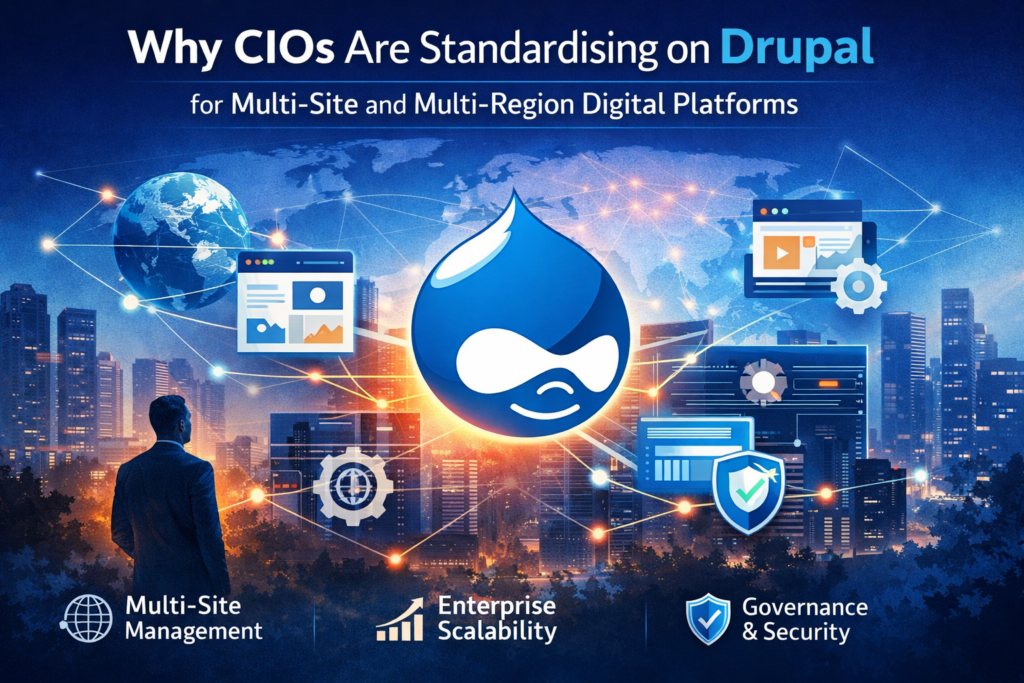
One of its key strengths is its ability to support multiple sites and regions within a single platform. This allows organisations to create a shared foundation while still supporting local variations where required.
Instead of managing separate platforms, organisations can standardise components, infrastructure and governance. This reduces duplication and improves consistency, while still allowing regional teams to operate effectively.
Structured content as a strategic asset
A defining characteristic of enterprise platforms is how they manage content.
In many CMS platforms, content is treated as individual pages. This approach works at a smaller scale but becomes limiting as complexity increases.
Drupal uses a structured content model.
Content is broken down into reusable components that can be managed centrally and deployed across multiple contexts. This makes it easier to maintain consistency, reuse content and integrate with other systems.
From a CIO perspective, this transforms content from a static output into a managed asset.
Structured content supports better governance, improves scalability and enables more flexible digital experiences.
Governance without sacrificing flexibility
One of the core challenges in enterprise digital environments is balancing central control with regional flexibility.
Too much centralisation creates bottlenecks and slows down execution. Too much decentralisation leads to inconsistency and increased risk.
Drupal supports a model where governance and flexibility can coexist.
Organisations can define global standards for templates, components and workflows, while allowing regional teams to manage their own content within those parameters. Role-based permissions and approval workflows ensure that control is maintained without restricting progress.
This approach enables consistency across the organisation while still supporting local responsiveness.
Integration within the enterprise ecosystem
Modern digital platforms do not operate in isolation.
They are part of a broader ecosystem that includes CRM systems, ERP platforms, marketing tools and identity systems. The ability to integrate effectively with these systems is essential.
Drupal’s architecture supports this through its API-first approach.
It can function as a central content hub, a presentation layer or an integration point between systems. This makes it well suited to organisations adopting composable or hybrid architectures, where multiple systems work together to deliver a unified experience.
For CIOs, this flexibility is critical. It ensures that the platform can evolve alongside the broader technology stack.
Security, stability and long-term viability
At an enterprise level, platform decisions are heavily influenced by risk.
Security, stability and long-term support are not optional considerations. They are fundamental requirements.
Drupal has a strong track record in environments where these factors are critical, including government and large-scale enterprise deployments. Its open architecture and active global community contribute to its long-term viability.
This provides a level of confidence for organisations making strategic platform investments.
When Drupal is the right choice
Drupal is not the right solution for every organisation.
For simple websites or smaller teams, it can introduce a level of complexity that is not required. However, for organisations dealing with multiple regions, complex content structures and governance requirements, that complexity becomes an advantage.
It provides the structure needed to manage scale effectively.
A change in how CIOs evaluate platforms
The way platforms are evaluated is changing.
CIOs are moving away from feature-based comparisons and focusing instead on how a platform supports the broader organisation. Key considerations now include governance, integration, scalability and long-term cost.
In this context, Drupal is not simply another CMS option.
It is a platform that supports enterprise-level digital architecture.
Final perspective
Most organisations do not intentionally create fragmented digital environments. They evolve into them over time.
The challenge is recognising when that fragmentation begins to impact performance, cost and control.
Those that take a proactive approach can simplify their digital estate, establish governance and create a scalable foundation for the future.
Drupal is not a universal solution, but for organisations looking to move from fragmented websites to a structured, governed and scalable platform, it is one of the strongest options available.