



The shift toward usable headless CMS
Headless CMS is no longer a niche concept.
For many enterprise organisations, it has become part of the broader move toward modern digital architecture. Platforms like Contentful helped define this space, particularly for engineering-led teams that needed flexibility and control.
But as adoption has grown, so has a different challenge.
Usability.
Many organisations have discovered that while headless CMS platforms offer significant technical advantages, they can be difficult for content teams to work with. The separation of content and presentation, while powerful, often creates friction for non-technical users.
This is where Storyblok has started to gain traction.
It sits in an interesting position. It retains the benefits of headless architecture, while introducing a more intuitive and visual editing experience.
For some organisations, that balance is exactly what has been missing.
What Storyblok actually changes
At a technical level, Storyblok follows the same core principles as other headless CMS platforms.
Content is structured. It is delivered via APIs. Front end applications control how that content is rendered.
What it adds is a visual layer.
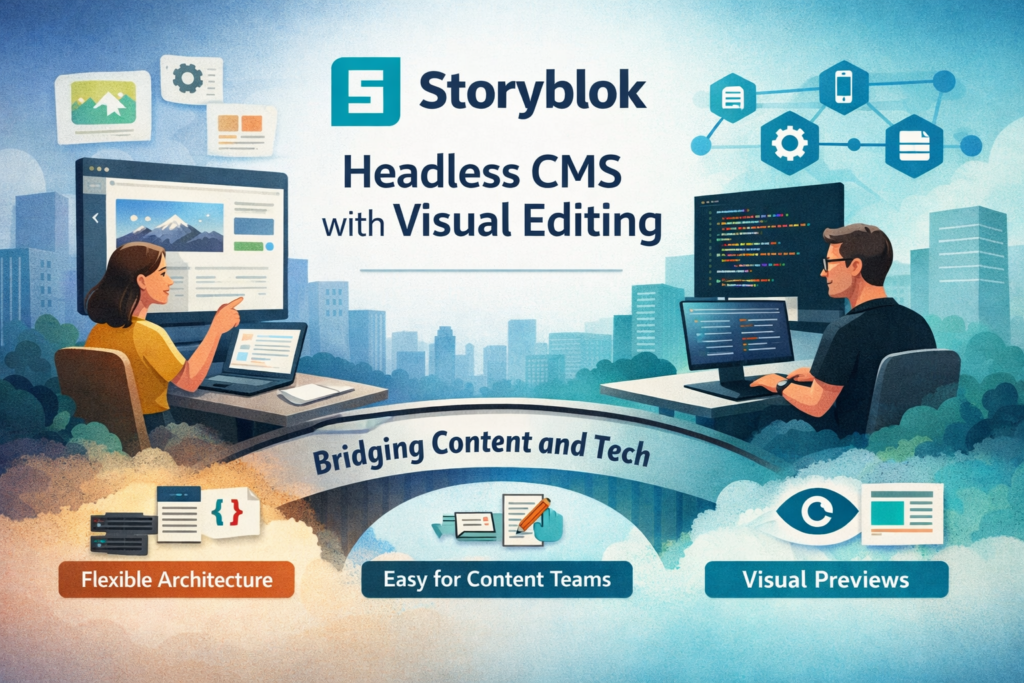
Content editors can see how content will appear as they create it. Components can be arranged visually. Changes can be previewed in context, rather than abstractly.
This may seem like a small difference, but in practice it is significant.
It reduces the gap between content creation and presentation. It makes the platform more accessible to non-technical users. It allows content teams to work with greater confidence.
For organisations where content plays a central role, this can have a meaningful impact on adoption and efficiency.
Where Storyblok works particularly well
Storyblok tends to perform best in environments where both technical flexibility and content usability are important.
This often includes organisations that are building modern front end experiences but still want content teams to operate independently.
In these scenarios, Storyblok provides a bridge.
Developers can build using modern frameworks and maintain full control over the front end. At the same time, content teams can manage and preview content without relying heavily on development support.
This balance is particularly valuable in organisations where digital teams are structured across both technical and marketing functions.
It allows each group to work effectively without creating unnecessary dependency.
The importance of visual editing at scale
One of the most underestimated challenges in headless CMS implementations is content team adoption.
When content is managed as structured data without clear visual context, it can be difficult for editors to understand how their work translates into the final experience.
This often leads to increased reliance on developers, slower content updates and frustration within teams.
Storyblok addresses this directly through its visual editor.
By allowing users to see changes in real time, it reduces uncertainty and improves confidence. Content editors can work more efficiently, and the feedback loop between content and presentation becomes much tighter.
At scale, this has operational benefits.
It reduces bottlenecks. It improves turnaround times. It allows content teams to take greater ownership of the platform.
The trade off between flexibility and simplicity
While Storyblok introduces usability improvements, it is still a headless CMS.
This means that many of the same considerations apply.
Front end applications still need to be built and maintained. Architecture still needs to be designed carefully. Content still needs to be structured effectively.
The presence of a visual editor does not remove these requirements.
What it does is make the platform more approachable for certain users.
For organisations with strong engineering capability, this is not a limitation. It is an enhancement. For those without that capability, the underlying complexity of headless architecture remains.
This is an important distinction.
Content modelling still matters
Like any headless CMS, Storyblok relies on well-designed content models.
The visual editor makes it easier to work with content, but it does not replace the need for structure.
Content types need to be defined clearly. Components need to be designed in a way that supports reuse and consistency. Relationships between content need to be considered.
If this is done well, Storyblok can be both powerful and intuitive.
If it is not, the platform can become difficult to manage, regardless of how user-friendly the interface appears.
This is a common point of failure across all headless implementations.
When Storyblok may not be the right fit
Storyblok is not the right solution for every organisation.
For highly complex enterprise environments with deep integration requirements and large scale content governance needs, platforms like Drupal may offer more control and flexibility.
Similarly, for organisations that are purely engineering-led and do not prioritise visual editing, other headless platforms may be sufficient.
There is also a consideration around scale.
While Storyblok is capable, organisations with extremely large and complex digital estates may require additional architectural planning to ensure long term scalability.
As with any platform decision, context matters.
What successful Storyblok implementations look like
Successful implementations tend to share a few common characteristics.
They start with a clear understanding of how content will be structured and used. Content modelling is treated as a foundational activity, not an afterthought.
They align technical and content teams early. Both groups understand how the platform works and how they will interact with it.
They design components carefully. The goal is to create a system that is flexible enough to support different use cases, while still being easy to manage.
They take a phased approach. Core functionality is delivered first, with additional capability introduced over time.
This reduces risk and allows teams to build confidence in the platform.
A more practical way to evaluate Storyblok
The decision to use Storyblok should not be based on features alone.
It should be based on how well it aligns with the organisation’s needs and capabilities.
For organisations that want the benefits of headless architecture without sacrificing usability, it can be a strong option.
For those that prioritise either extreme flexibility or extreme simplicity, other platforms may be more appropriate.
The key is to understand the trade offs.
Final perspective
Storyblok represents an evolution in how headless CMS platforms are delivered.
It addresses one of the key challenges in the space, which is usability for content teams, while still supporting modern development practices.
For many organisations, this balance is valuable.
However, it does not remove the need for careful planning, strong architecture and clear ownership.
Like any platform, its success depends on how it is implemented.
For CIOs and digital leaders, the goal is not to choose the most popular or the most modern solution.
It is to choose the one that best aligns with the organisation’s structure, capabilities and long term objectives.
Storyblok can be a strong fit in the right context.
The challenge, as always, is making that decision with clarity.