



The uncomfortable truth about ERP investments
Microsoft Dynamics 365 is not the problem.
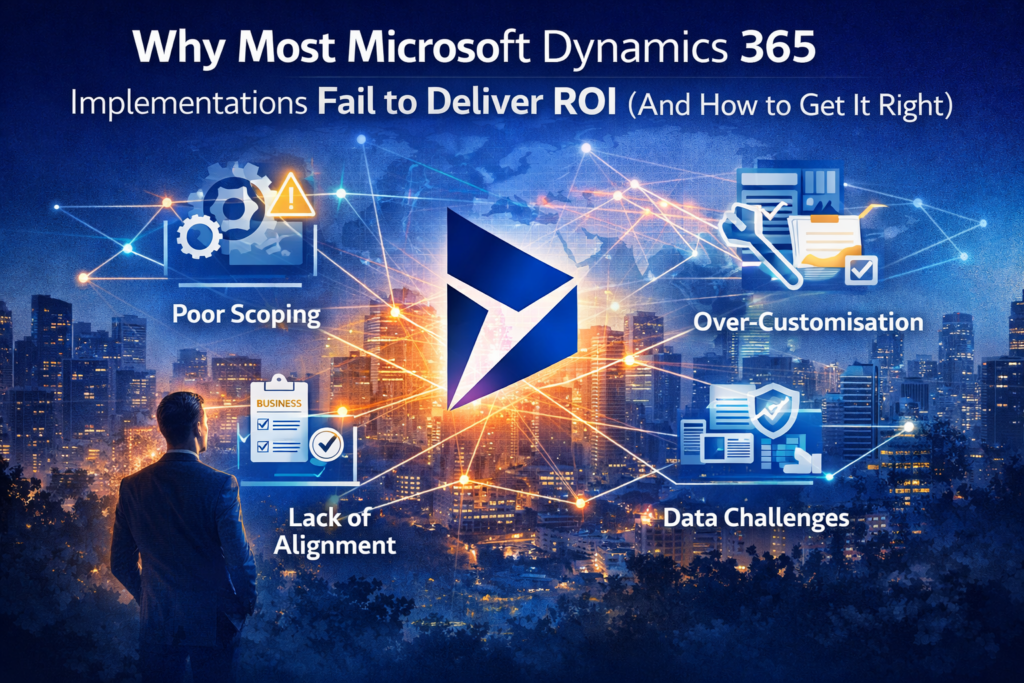
That may sound counterintuitive given how many organisations feel underwhelmed after implementation, but the reality is consistent across the market. When Dynamics 365 fails to deliver return on investment, it is rarely because of the platform itself. It is because of the way it has been approached, scoped and executed.
This distinction matters.
Because most organisations heading into a D365 implementation are not just buying software. They are committing to a significant operational and financial shift. They are expecting improvements in efficiency, visibility and decision making. In many cases, they are expecting transformation.
When those expectations are not met, the consequences extend well beyond the technology. Confidence drops. Internal stakeholders become disengaged. The system becomes tolerated rather than embraced.
Understanding why this happens is the first step toward getting it right.
What success actually looks like
A successful Dynamics 365 implementation is not defined by whether the system goes live.
It is defined by whether the business operates better because of it.
That includes clearer processes, improved reporting, reduced manual effort and stronger alignment across teams. It also includes the ability to adapt over time without excessive cost or complexity.
This is an important distinction because many implementations are considered successful at a technical level, while failing at a business level. The system is delivered, but the outcomes are not.
That gap is where most ROI is lost.
Where implementations start to go wrong
A technology first mindset
One of the most common issues is that implementations begin with the system rather than the business.
The focus quickly shifts to configuration, modules and features. Workshops become centred on what the platform can do, rather than what the organisation needs to achieve.
This leads to a solution that reflects the system’s capabilities rather than the business’s priorities.
A better approach is to start with outcomes. What needs to improve. Where the inefficiencies are. What success looks like in measurable terms. Only then should the platform be introduced as the enabler.
Without this alignment, even a well built system can miss the mark.
Trying to replicate the past
Another frequent challenge is the tendency to recreate legacy systems.
Organisations bring forward existing processes, structures and inefficiencies, and attempt to replicate them within Dynamics 365. This often results in unnecessary complexity and missed opportunities for improvement.
ERP implementations should not be about copying what exists. They should be about refining and simplifying how the business operates.
When this does not happen, the new system inherits the same problems as the old one, often with added layers of complexity.
Overengineering from day one
It is common to see implementations that try to deliver everything at once.
Multiple modules, complex workflows and extensive customisation are introduced early in the project. The intention is usually to deliver a comprehensive solution, but the outcome is often the opposite.
Complexity increases. Timelines extend. Costs rise. Risk becomes harder to manage.
More importantly, the organisation is forced to absorb too much change at once.
A phased approach is far more effective. Establish a solid foundation. Deliver core functionality. Then expand in a controlled and deliberate way.
This is how sustainable value is created.
Lack of clear ownership
Technology projects require business ownership.
Without it, decision making becomes fragmented and accountability becomes unclear. This is particularly evident in ERP implementations, where multiple stakeholders are involved across different functions.
When there is no clear owner on the client side, the implementation partner is often left to fill the gap. This can lead to decisions being made without full business context or alignment.
Strong internal ownership ensures that decisions are guided by business priorities, not just technical considerations.
Underestimating data complexity
Data is often one of the most underestimated aspects of any ERP project.
Legacy data is rarely clean. Structures vary. Definitions are inconsistent. Historical data may not align with future requirements.
When this is not addressed early, it creates issues later in the project. Migration becomes more complex. Reporting becomes less reliable. Confidence in the system is affected.
Data should be treated as a core workstream, not a secondary task.
The impact of getting it wrong
When these issues combine, the impact is significant.
Projects take longer than expected. Costs exceed initial estimates. Adoption is slower. The system becomes harder to maintain and evolve.
In some cases, organisations continue to rely on manual processes alongside the new system because it does not fully meet their needs.
At that point, the return on investment is compromised.
The platform may still function, but it is not delivering the value it was intended to provide.
What successful organisations do differently
The organisations that achieve strong outcomes from Dynamics 365 tend to approach it differently from the outset.
They focus less on the system and more on the outcomes they want to achieve. They define success clearly and align stakeholders around those objectives.
They simplify before they build. Existing processes are reviewed and refined. Unnecessary complexity is removed. The goal is not to replicate the past, but to improve it.
They take a phased approach. Core functionality is delivered first, creating a stable foundation. Additional capability is introduced over time, based on priority and value.
They establish clear ownership. There is a defined business lead who is accountable for outcomes, not just delivery. This ensures that decisions are aligned with organisational goals.
They invest in data. Data quality, structure and governance are addressed early, reducing risk and improving long term usability.
These behaviours are not complex, but they require discipline and clarity.
The role of the implementation partner
The choice of partner plays a significant role in the success of a Dynamics 365 program.
A partner that focuses purely on delivery will follow instructions, configure the system and complete the build. That may be sufficient for a straightforward implementation, but it is not enough for a transformation initiative.
A stronger partner will challenge assumptions. They will question whether requirements are necessary or whether there is a simpler way to achieve the same outcome. They will guide the organisation toward better decisions, even when those conversations are not always easy.
This is particularly important when it comes to scope and complexity.
It is easy to agree to additional features and customisation during the early stages of a project. It is much harder to manage the consequences later.
An experienced partner helps maintain focus on what matters, ensuring that the solution remains aligned with business outcomes.
A more effective approach to D365
A practical way to approach Dynamics 365 is to treat it as a program rather than a project.
Instead of aiming for a single delivery milestone, focus on continuous improvement.
Start with a clear understanding of the current state and the desired future state. Identify the most critical areas for improvement. Deliver those first.
Ensure that governance is in place. Define roles, responsibilities and decision making processes. Maintain visibility of progress and performance.
Build momentum through early wins. Demonstrate value quickly. Use that momentum to support further investment and adoption.
This approach reduces risk, improves alignment and increases the likelihood of achieving meaningful outcomes.
Final perspective
Dynamics 365 is a capable platform.
When implemented well, it can deliver significant improvements across operations, reporting and decision making. When implemented poorly, it can become another system that fails to meet expectations.
The difference is not the technology.
It is the approach.
Organisations that focus on outcomes, simplify their processes and maintain strong ownership are far more likely to succeed. Those that prioritise speed, complexity and feature coverage often struggle to realise value.
For CIOs and business leaders, the key question is not whether Dynamics 365 is the right platform.
It is whether the organisation is prepared to approach the implementation in a way that will allow it to deliver real, measurable impact.
That is where ROI is won or lost.