


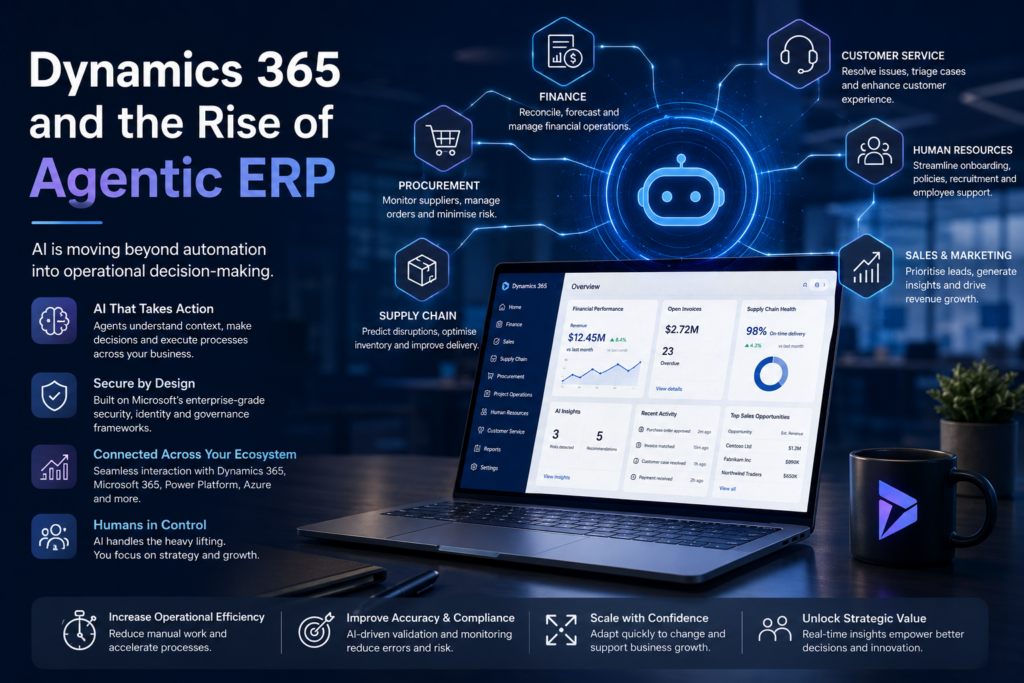

For years, organisations have pursued ERP modernisation with a relatively clear objective: centralise operations, improve visibility and reduce manual effort.
That journey evolved again with cloud ERP platforms like Microsoft Dynamics 365, where businesses gained greater scalability, integration capability and real-time operational insight.
Now, the next transformation is already underway.
The rise of “Agentic AI” is shifting enterprise technology beyond simple automation and into something far more significant: systems capable of understanding context, initiating actions and executing operational processes with minimal human intervention.
Microsoft’s continued expansion of AI capabilities across Dynamics 365, Copilot and the broader Power Platform ecosystem signals a major architectural shift in how ERP systems will operate over the coming decade.
This is no longer simply about AI-generated summaries or chatbot assistance.
ERP systems are becoming active operational participants.
The Shift From Workflow Automation to Agentic Operations
Traditional business automation follows predefined logic.
A workflow is configured.
A trigger occurs.
A predefined sequence executes.
While highly valuable, these automations are still fundamentally deterministic.
Agentic AI introduces a different model entirely.
Rather than simply following static rules, AI agents can:
- interpret intent
- analyse operational context
- access live enterprise data
- make conditional decisions
- orchestrate multiple systems
- execute business processes autonomously
- continuously adapt based on outcomes
This fundamentally changes the role enterprise systems play inside organisations.
Historically, ERP platforms acted primarily as systems of record.
Increasingly, they are evolving into systems of operational execution.
Why Dynamics 365 Is Positioned at the Centre of This Transition
Microsoft has quietly built one of the strongest foundations for enterprise AI adoption through the convergence of:
- Dynamics 365
- Microsoft Fabric
- Azure AI
- Power Platform
- Dataverse
- Copilot Studio
- Microsoft Graph
- enterprise-grade security and identity management
Unlike standalone AI vendors, Microsoft already owns much of the operational ecosystem businesses rely on daily.
This matters enormously.
Agentic AI only becomes truly valuable when it can securely interact with live operational systems.
For most organisations, that includes:
- ERP platforms
- CRM systems
- finance environments
- procurement systems
- customer service workflows
- collaboration platforms
- document repositories
- reporting environments
Dynamics 365 increasingly acts as the operational core connecting these systems together.
Why the Model Context Protocol Matters
One of the most important developments enabling this shift is the emergence of standardised AI interoperability layers like the Model Context Protocol (MCP).
Historically, AI integration has been fragmented.
Businesses often needed to:
- build custom APIs
- create isolated connectors
- manage brittle integrations
- manually map business logic
- maintain duplicated orchestration layers
This complexity limited scalability.
The MCP approach changes this by creating a structured framework that allows AI models to securely understand and interact with enterprise systems in real time.
In practical terms, this means AI agents can:
- retrieve operational data
- navigate ERP interfaces
- execute business logic
- interact with workflows
- trigger transactions
- coordinate actions across platforms
without requiring entirely bespoke development for every scenario.
This creates a far more scalable foundation for enterprise AI adoption.
ERP Systems Are Becoming Operational Interfaces for AI
One of the biggest conceptual shifts organisations need to understand is this:
The future user of ERP systems may increasingly be AI itself.
Human users will still exist, but many operational interactions will occur through intelligent agents acting on behalf of employees, departments or entire business functions.
This changes how organisations think about ERP architecture.
Historically, ERP optimisation focused heavily on:
- user interfaces
- navigation efficiency
- data entry processes
- reporting visibility
- workflow approvals
Increasingly, organisations must also optimise for:
- machine-readable business logic
- structured operational context
- clean master data
- API accessibility
- permission frameworks
- event-driven architectures
- semantic interoperability
In many ways, businesses are now preparing ERP environments not just for employees, but for AI workers.
What Agentic ERP Could Look Like in Practice
Although the technology is still evolving rapidly, practical enterprise use cases are already emerging.
Financial Operations
AI agents may soon autonomously:
- reconcile accounts
- investigate transaction anomalies
- validate expense claims
- prepare month-end processes
- identify compliance exceptions
- generate audit summaries
- forecast cash flow risks
Rather than simply assisting finance teams, AI increasingly becomes embedded within operational execution itself.
Supply Chain and Procurement
Within supply chain environments, AI agents could:
- monitor inventory disruptions
- identify supplier delays
- reroute procurement workflows
- recommend sourcing alternatives
- initiate replenishment actions
- coordinate logistics escalations
This creates a far more adaptive operational model compared to traditional static workflows.
Customer Service
Customer service environments are already seeing major AI acceleration.
Agentic service capabilities may include:
- autonomous case triage
- escalation management
- sentiment analysis
- proactive service outreach
- cross-platform issue resolution
- automated knowledge retrieval
Importantly, the AI is not simply generating responses.
It is coordinating operational outcomes.
Human Resources
HR operations are also likely to become increasingly agent-driven.
Potential examples include:
- onboarding coordination
- policy compliance monitoring
- employee workflow routing
- leave management
- recruitment screening
- training recommendations
Again, the operational distinction matters.
The AI is not just informing HR teams.
It is actively participating in HR processes.
The Importance of Data Quality in Agentic ERP
One reality is becoming increasingly clear:
AI systems amplify the quality of the operational environments they interact with.
Poor ERP data creates poor AI outcomes.
This means organisations adopting Agentic AI must prioritise:
- master data governance
- process consistency
- system standardisation
- integration quality
- security frameworks
- operational documentation
Businesses with fragmented ERP environments may struggle significantly as AI adoption accelerates.
In contrast, organisations with mature operational foundations are likely to gain disproportionate competitive advantage.
The AI itself is only part of the equation.
The surrounding operational architecture matters just as much.
Why Governance Will Become Critically Important
As AI agents gain the ability to execute operational actions, governance becomes significantly more important.
Businesses must carefully define:
- approval boundaries
- execution permissions
- escalation rules
- audit visibility
- accountability frameworks
- compliance controls
- human oversight requirements
This introduces new operational and ethical considerations.
For example:
- Should AI agents approve payments?
- Can AI autonomously modify procurement terms?
- How should AI-driven operational decisions be audited?
- What level of human intervention remains mandatory?
These questions will increasingly become board-level governance discussions.
Security and Identity Will Define Enterprise Adoption
One reason Microsoft is particularly well positioned in this space is its existing enterprise identity ecosystem.
Agentic AI introduces substantial security considerations because the AI is no longer simply reading information.
It may also:
- execute transactions
- access sensitive systems
- manipulate operational records
- trigger business processes
Identity management therefore becomes foundational.
Microsoft’s integration across:
- Azure Active Directory
- Microsoft Entra
- role-based access control
- Purview governance
- security monitoring
provides a critical enterprise advantage.
Businesses adopting Agentic ERP will require extremely strong visibility into what AI systems can access and what they are permitted to do.
Why This Is Bigger Than Productivity
Many discussions around AI remain overly focused on productivity.
While productivity gains are real, the broader transformation is operational.
Agentic ERP changes how businesses function.
It reshapes:
- operational scalability
- organisational structure
- workforce allocation
- process design
- service delivery
- decision velocity
The organisations achieving the strongest outcomes may not simply reduce manual effort.
They may redesign entire operating models around AI-assisted execution.
This is a far larger transformation than incremental efficiency improvement.
The Human Role Is Evolving, Not Disappearing
One of the biggest misconceptions surrounding Agentic AI is the assumption that human involvement disappears.
In reality, human roles are likely to evolve upward.
As AI increasingly handles repetitive operational coordination, human teams may focus more heavily on:
- strategic oversight
- exception management
- relationship building
- governance
- innovation
- operational optimisation
- decision-making
In many cases, employees become orchestrators of AI-driven operations rather than direct executors of manual tasks.
This creates both opportunity and organisational disruption.
Businesses will need to rethink:
- workforce structures
- skills development
- leadership capability
- operational accountability
The transition will likely be as much cultural as technical.
Dynamics 365 Partners Will Need to Evolve Rapidly
The rise of Agentic ERP also changes the role of implementation and consulting partners.
Historically, Dynamics 365 projects often focused on:
- system configuration
- custom development
- integrations
- reporting
- workflow setup
Increasingly, organisations will require partners capable of advising on:
- AI governance
- operational redesign
- data architecture
- AI orchestration
- security frameworks
- enterprise automation strategy
- process intelligence
- organisational change management
Technical ERP capability alone will no longer be sufficient.
The strongest partners will combine operational consulting with deep AI and integration expertise.
Why Businesses Should Start Preparing Now
Many organisations assume widespread Agentic ERP adoption is still years away.
In reality, the foundational shift is already happening.
Businesses should already be evaluating:
- ERP data maturity
- integration architecture
- automation readiness
- governance frameworks
- AI security policies
- operational bottlenecks
- process standardisation
The organisations that prepare early will likely move significantly faster once Agentic platforms mature further.
Importantly, preparation does not necessarily mean deploying autonomous AI immediately.
It means building operational environments capable of supporting it when appropriate.
The Future ERP May Look Very Different
Over the next five years, ERP systems may evolve dramatically.
Interfaces may become increasingly conversational.
Workflows may become increasingly autonomous.
Operational coordination may shift heavily toward AI agents operating continuously in the background.
The ERP of the future may no longer primarily be software employees log into.
It may become an intelligent operational layer coordinating business activity across the organisation in real time.
This represents one of the most significant shifts enterprise technology has seen since the rise of cloud computing itself.
Thinking Ahead
The rise of Agentic AI marks a major evolution in enterprise operations.
Microsoft’s continued investment across Dynamics 365, Copilot, Power Platform and interoperability frameworks like MCP signals where the market is heading: toward intelligent operational ecosystems capable of executing business processes autonomously and at scale.
For organisations already invested in Dynamics 365, the opportunity is substantial.
However, the businesses that achieve the strongest outcomes will not simply deploy AI tools.
They will rethink operational architecture, governance, integration strategy and organisational design around a future where AI becomes an active operational participant.
The transition from manual ERP interaction to AI-orchestrated enterprise operations is no longer theoretical.
It is already underway.