



Cutting through the noise around headless
Headless CMS has become one of the most talked about shifts in digital architecture over the past few years.
For many organisations, it is positioned as the natural next step. More flexible, more scalable, better aligned to modern development practices. Platforms like Contentful are often at the centre of that conversation.
At a surface level, the argument is compelling.
Decouple content from presentation. Deliver content via APIs. Build front ends using modern frameworks. Create once and publish everywhere.
The challenge is that this narrative is often oversimplified.
Headless is not inherently better. It is different. And whether it is the right choice depends heavily on the organisation, its maturity and what it is trying to achieve.
Understanding when it makes sense, and when it does not, is where most of the value lies.
What headless actually means in practice
At its core, a headless CMS separates content management from how that content is delivered.
Instead of managing pages within a system that controls both content and presentation, content is stored in a structured format and exposed via APIs. Front end applications then consume that content and render it however they choose.
In platforms like Contentful, this approach is taken further.
Content is modelled as structured data. It is designed to be reusable, flexible and independent of any single channel. That content can then be used across websites, mobile applications, digital products and other touchpoints.
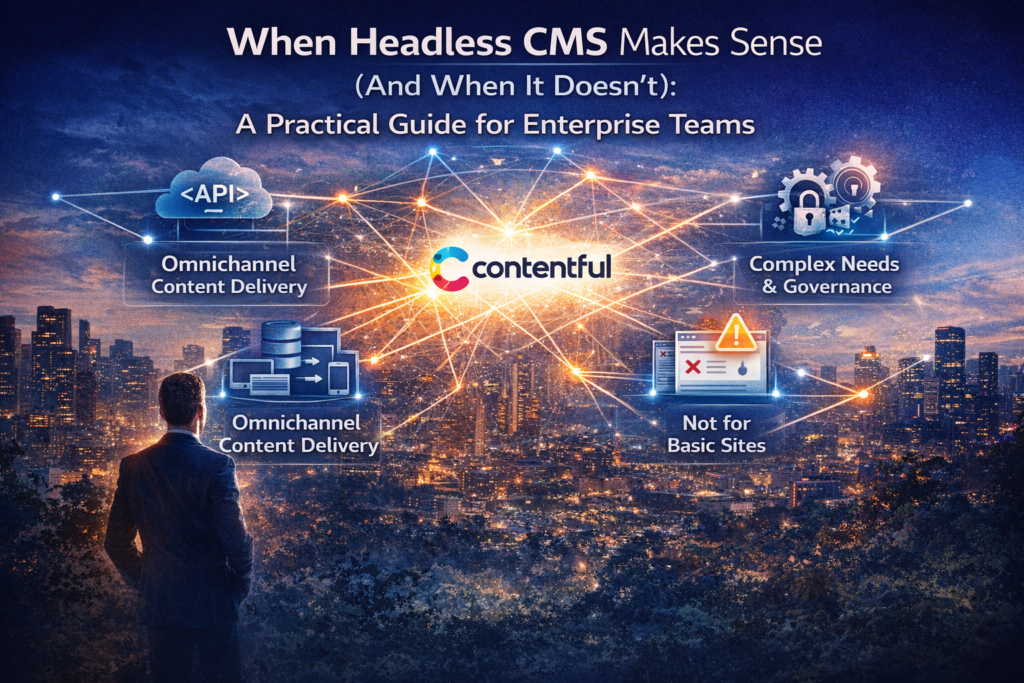
For organisations operating across multiple channels, this can be powerful.
But it also introduces a different level of responsibility.
Where Contentful and headless architecture work well
Headless CMS platforms tend to perform best in environments where flexibility and scale are genuine requirements, not just aspirations.
Organisations that benefit most typically have multiple digital touchpoints. They are delivering content across websites, applications and potentially other platforms. They need consistency, but they also need the ability to adapt quickly.
In these scenarios, structured content becomes a significant advantage.
Content can be created once and reused across channels. Updates can be made centrally and reflected everywhere. Front end teams are not constrained by the limitations of a traditional CMS, allowing them to build richer and more tailored experiences.
Contentful is particularly strong in this space because it is designed as an API first platform. It integrates well into modern technology stacks and supports composable architectures where different systems work together.
For organisations with established engineering capability, this opens up a high degree of flexibility.
It allows digital platforms to evolve without being tightly coupled to a single system.
The reality most organisations underestimate
Where headless often becomes challenging is in the gap between concept and execution.
The idea of decoupling content and presentation is appealing. The reality is that it shifts complexity rather than removing it.
In a traditional CMS, much of the functionality required to render a website is built into the platform. With headless, that responsibility moves to the front end.
This means that every element of the experience needs to be built and maintained separately.
Navigation, page layouts, content rendering, previews, search and integrations all need to be handled across multiple layers. This increases both the initial build effort and the ongoing maintenance requirement.
For organisations without strong front end capability, this can quickly become a constraint.
What was intended to create flexibility can instead create dependency.
Content modelling is more complex than it looks
Another area that is often underestimated is content modelling.
In a headless environment, content is not just entered into pages. It needs to be designed as a structured system.
This requires careful planning.
Content types need to be defined. Relationships between content need to be mapped. Consideration needs to be given to how content will be reused and extended over time.
If this is done well, it creates a powerful and scalable foundation.
If it is done poorly, it creates confusion and inconsistency. Content becomes difficult to manage. Teams struggle to understand how to use the system. The benefits of headless are reduced.
This is one of the key areas where many implementations fall short.
The impact on content teams
Headless CMS platforms also change how content teams work.
In traditional systems, content editors are often working within a visual environment. They can see how content will appear as they create it. Page builders and templates provide a level of familiarity.
In a headless environment, that experience is different.
Content is managed as structured data. The connection between what is entered and how it is presented is less direct. Preview capabilities exist, but they are not always as intuitive.
For content teams, this can require a shift in mindset.
Without proper training and support, adoption can be slower. The system may be seen as more complex than necessary, even if it is more powerful in the long term.
This is an important consideration that is often overlooked in early decision making.
When headless does not make sense
Headless CMS is not the right solution for every organisation.
If the primary requirement is a marketing website with relatively standard functionality, the additional complexity may not be justified.
Organisations without strong internal or partner engineering capability may find themselves relying heavily on external support. This can increase cost and reduce agility.
Similarly, if content teams need a high degree of control over layout and presentation, a traditional or hybrid CMS may be more appropriate.
The key point is that headless is not a default choice. It is a strategic one.
What a successful Contentful implementation looks like
When headless is the right choice, the difference between success and failure is largely in how it is approached.
Successful implementations start with a clear understanding of the organisation’s needs. Not just what is required today, but how the platform needs to evolve over time.
Content modelling is treated as a core activity. Time is invested in designing a structure that is intuitive, scalable and aligned to how the business operates.
Front end architecture is planned carefully. Decisions are made with long term maintainability in mind, not just initial delivery.
There is alignment between technical teams and content teams. Both understand how the system works and how they contribute to its success.
Importantly, implementations are often phased.
Rather than attempting to deliver everything at once, organisations focus on establishing a solid foundation. Additional capability is introduced over time, based on priority and value.
This reduces risk and supports better adoption.
A more balanced way to think about headless
The conversation around headless CMS has often been framed in absolute terms.
Traditional versus modern. Legacy versus future.
In reality, the decision is more nuanced.
Headless is a powerful approach when applied in the right context. It enables flexibility, supports modern development practices and aligns well with complex digital ecosystems.
At the same time, it introduces additional complexity that needs to be managed.
For CIOs and digital leaders, the goal is not to follow trends. It is to make decisions that align with the organisation’s capabilities and objectives.
That means understanding both the strengths and the trade offs.
Final perspective
Contentful and other headless platforms represent an important evolution in how digital platforms are built.
They provide a level of flexibility and scalability that is difficult to achieve with traditional approaches.
However, they are not a universal solution.
The organisations that benefit most are those that approach headless with clarity. They understand why they are choosing it. They invest in the areas that matter. They align their teams around a shared approach.
Those that adopt it without that clarity often find themselves dealing with increased complexity and reduced return.
Headless CMS makes sense when it solves a real problem.
When it does not, it becomes another layer of technology that adds more than it delivers.
The difference lies in the decision, not the platform.