



As organisations continue modernising operations, many are consolidating technology ecosystems to reduce complexity, improve integration and support scalability.
Microsoft’s business application ecosystem has become a major part of this shift.
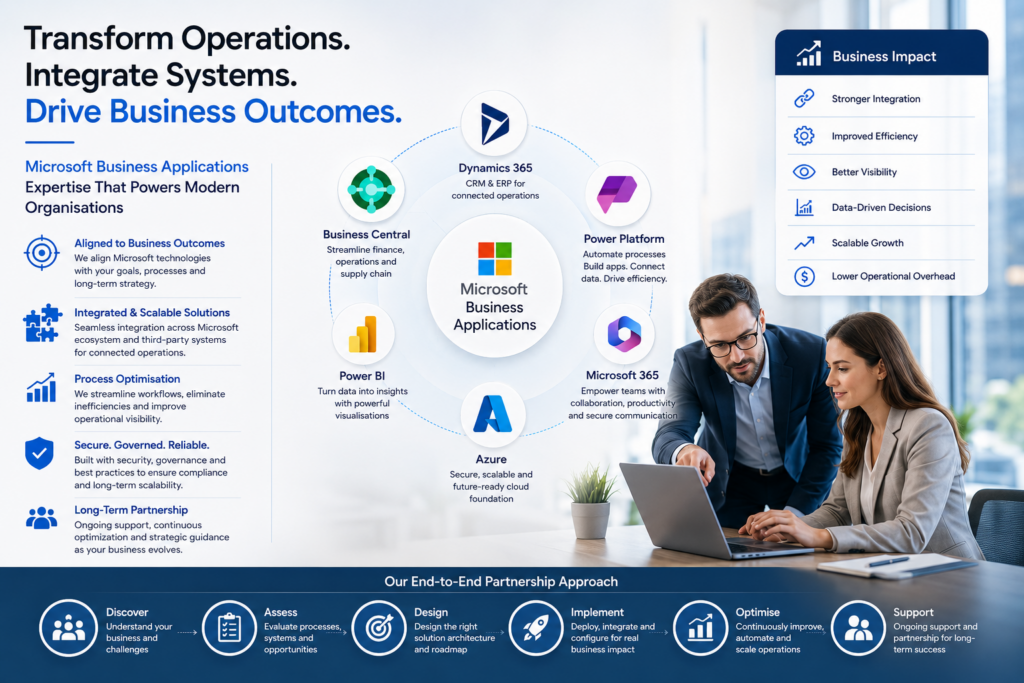
Platforms including:
- Microsoft Dynamics 365
- Power Platform
- Business Central
- Power BI
- Microsoft 365
- Azure
…now support a wide range of operational, financial and customer engagement functions across modern businesses.
However, implementing these technologies successfully requires more than software licensing or technical deployment.
Businesses increasingly rely on experienced Microsoft business applications partners to align technology with operational outcomes and long-term digital strategy.
What Is a Microsoft Business Applications Partner?
A Microsoft business applications partner helps organisations implement, customise, integrate and optimise Microsoft business technologies.
This may include:
- CRM implementation
- ERP deployment
- workflow automation
- reporting and analytics
- custom application development
- systems integration
- cloud transformation
- process optimisation
The role of the partner extends beyond software configuration.
The right partner helps organisations redesign operations, improve visibility and create scalable digital foundations.
Why Businesses Are Consolidating Around Microsoft Technologies
Many organisations already operate within the Microsoft ecosystem through tools such as:
- Outlook
- Teams
- SharePoint
- Excel
- Azure Active Directory
- Microsoft 365
Expanding into Dynamics 365 and Power Platform allows businesses to create more connected operational environments without introducing disconnected third-party ecosystems.
Benefits often include:
- stronger integration
- improved security governance
- centralised identity management
- better reporting visibility
- reduced duplication
- streamlined workflows
This creates opportunities for more unified digital operations.
Dynamics 365 and Operational Transformation
Microsoft Dynamics 365 combines CRM and ERP capabilities within a connected business platform.
Organisations use Dynamics 365 to manage:
- customer engagement
- sales operations
- marketing automation
- finance
- project management
- field services
- supply chain operations
- customer support
Because of its flexibility, Dynamics 365 can support highly customised operational environments.
However, this flexibility also increases implementation complexity.
Successful deployments require careful planning, governance and business alignment.
The Rise of Power Platform
Microsoft Power Platform has rapidly become one of the most important business automation ecosystems available to organisations.
Power Platform includes:
- Power Apps
- Power Automate
- Power BI
- Copilot capabilities
These technologies allow businesses to:
- automate manual workflows
- create internal applications
- improve reporting
- connect systems
- streamline approvals
- reduce operational overhead
Power Platform has significantly lowered the barrier to business automation and custom application delivery.
Integration Is a Major Priority
Modern organisations operate across increasingly complex technology environments.
Businesses often need to integrate Microsoft platforms with:
- websites
- finance systems
- ERP platforms
- third-party SaaS applications
- customer portals
- data warehouses
- mobile applications
A strong Microsoft business applications partner understands integration architecture and long-term scalability.
Poor integration design can create operational fragmentation and technical debt.
Business Process Optimisation Matters More Than Technology
One of the most common mistakes in digital transformation projects is focusing too heavily on software features rather than operational outcomes.
Technology should support business processes, not dictate them.
Experienced Microsoft partners help organisations:
- review workflows
- identify inefficiencies
- simplify operations
- reduce duplication
- improve visibility
- support scalability
This process-focused approach delivers stronger long-term outcomes than technology deployment alone.
Low-Code Development Is Changing Business Technology
One of the biggest shifts in recent years has been the rise of low-code development platforms.
Power Apps allows organisations to rapidly develop:
- internal operational tools
- mobile applications
- approval systems
- reporting dashboards
- workflow applications
This enables businesses to solve operational challenges more quickly while reducing development overhead.
However, governance and architecture remain critical.
Without proper oversight, low-code environments can become difficult to maintain at scale.
Why Long-Term Support Matters
Business applications continue evolving after implementation.
Processes change.
Teams grow.
Systems expand.
Business requirements shift.
As a result, organisations increasingly seek long-term technology partners rather than short-term implementation vendors.
Ongoing support may include:
- optimisation
- enhancements
- user adoption
- integration expansion
- reporting improvements
- governance management
- automation refinement
Long-term partnership capability is often a major factor in project success.
Choosing a Microsoft Business Applications Partner
Businesses evaluating Microsoft partners should consider:
- technical certifications
- Dynamics 365 capability
- Power Platform expertise
- integration experience
- custom development capability
- operational understanding
- support capability
- strategic consulting experience
The strongest partners combine technical expertise with commercial and operational insight.
Looking Ahead
Microsoft business applications are increasingly becoming central operational platforms for modern organisations.
However, technology alone does not create transformation.
Businesses achieve stronger outcomes when implementation is aligned with operational strategy, process improvement and long-term scalability.
The right Microsoft business applications partner helps organisations move beyond software deployment toward connected, efficient and scalable digital operations.