



A mobile app built for internal operations or customer-facing services carries different stakes than a typical consumer app, and getting the foundations wrong often surfaces only once real users, real data, and real transaction volumes hit the system. Proper enterprise mobile app development accounts for this from day one, treating security, scalability, and integration as core requirements rather than problems to solve after launch.
Enterprise Mobile App Development: Getting the Foundations Right
Enterprise apps handle sensitive data, internal workflows, and often financial transactions, which makes them a genuine target worth taking seriously. Research from 2026 puts the number of enterprise apps carrying at least one critical security vulnerability above 60 per cent, almost always tracing back to security treated as an afterthought rather than built into the architecture from the start.
Getting this right means designing for security, scalability, and integration together, not bolting one onto the others once the build is mostly finished. A well-planned enterprise app supports current business needs while staying flexible enough to grow, whether that means supporting more users, new departments, or business processes nobody anticipated when the project kicked off.
What Belongs on Every Business’s Checklist
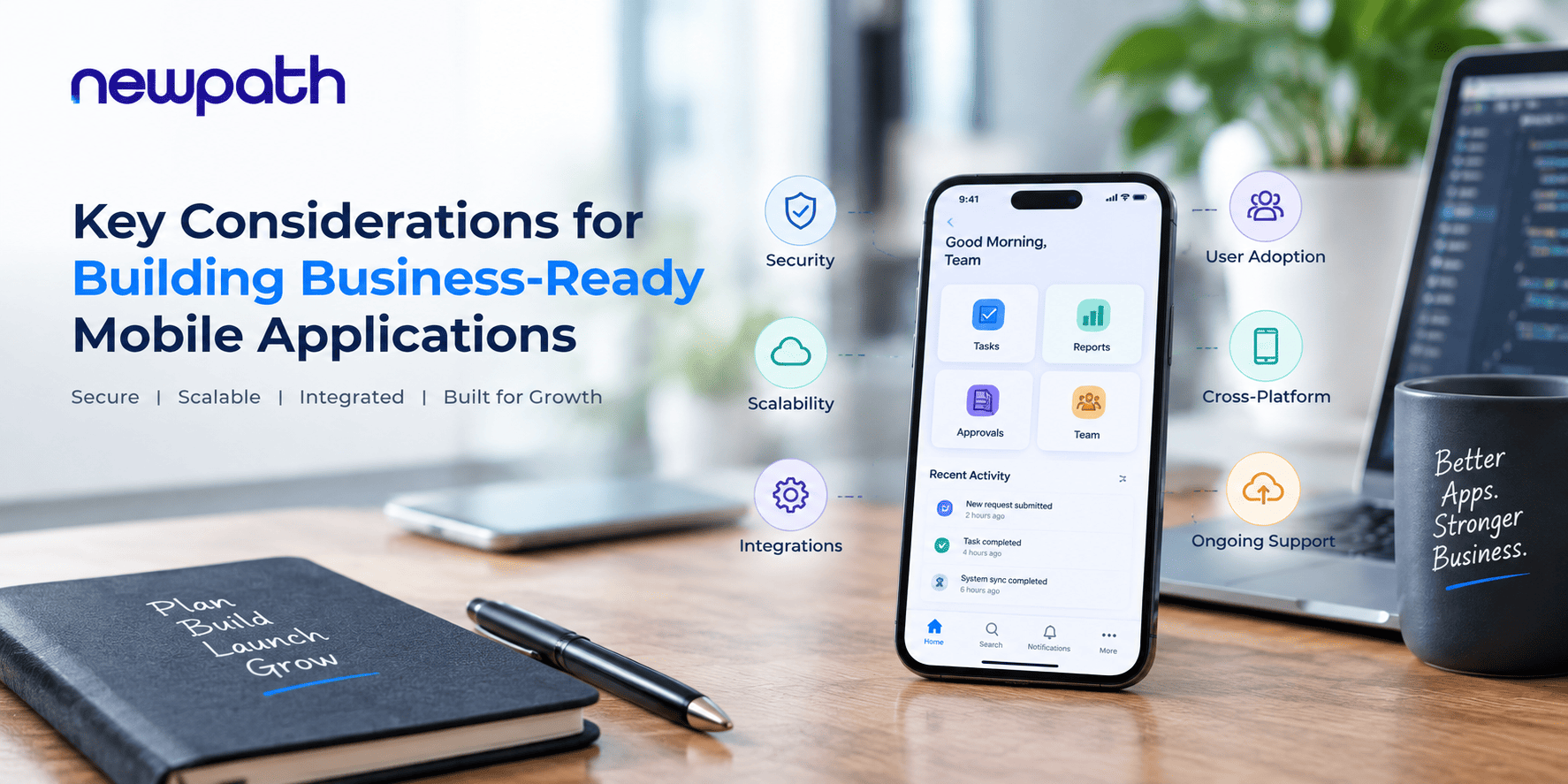
A handful of considerations consistently separate a genuinely business-ready app from one that causes problems within its first year:
- Strong authentication, including single sign-on and multi-factor authentication, without adding unnecessary friction for everyday users
- Role-based access control, so employees only see the data and functions relevant to their responsibilities
- Cloud-native, modular architecture built to scale across users, transaction volumes, and integrations without a costly rebuild
- Offline functionality for teams working in low-connectivity environments, particularly relevant for field-based operations
- Clean integration with existing systems, including CRM, ERP, and legacy platforms already in daily use
- A realistic plan for ongoing maintenance, since security updates and new features are an ongoing requirement, not a one-time task
Businesses that address each of these during planning, rather than discovering gaps after launch, consistently end up with apps that hold up under real operational pressure.
How Custom Mobile Applications Improve Business Efficiency
Generic, off-the-shelf software solves a narrow set of problems reasonably well, but it rarely matches how a specific business actually operates. Custom mobile applications close that gap directly, built around real workflows rather than forcing a business to adapt around a template’s limitations.
This translates into measurable operational gains. Staff spend less time on manual workarounds when an app genuinely reflects how their team works. Managers get cleaner, more reliable reporting when data flows automatically between systems rather than requiring manual reconciliation. And teams in the field gain real independence when an app is built to function properly offline rather than assuming constant connectivity.
Custom development costs more upfront than an off-the-shelf alternative, typically ranging from around $20,000 for a straightforward build to $300,000 or more for complex, highly integrated systems, but the return tends to justify it for businesses with genuine operational complexity. Industries like logistics, healthcare, finance, and manufacturing rely particularly heavily on this kind of tailored approach, since the operational demands in these sectors rarely fit neatly into a generic template built for a broad market. A well-built enterprise app frequently pays for itself through reduced manual work, fewer errors, and considerably better visibility into daily operations.
iPhone App Development: Meeting Users on Their Preferred Platform
For many businesses, a meaningful share of staff or customers work primarily on Apple devices, making dedicated iPhone app development an important part of the overall strategy rather than an afterthought bolted onto an Android-first build. Building natively for iOS allows an app to take full advantage of Apple’s security frameworks, performance capabilities, and the interface conventions iPhone users already expect from the other apps on their device.
For enterprise use cases specifically, this often means integrating with Apple’s own device management and security tools, ensuring an app fits smoothly into a business’s existing approach to managing company devices and protecting sensitive data across a mobile workforce. Businesses running a mixed fleet of devices also need to weigh whether a native iOS build, a native Android build, or a cross-platform approach best serves their actual user base, a decision that depends heavily on where staff and customers already sit rather than a one-size assumption applied across the board.
Planning for the Realistic Timeline
Enterprise mobile projects typically take anywhere from three to twelve months depending on complexity, and rushing this timeline tends to produce exactly the security and scalability problems mentioned earlier. A properly staged project, moving through discovery, design, development, integration, and thorough testing, gives a business considerably more confidence that the finished app will actually hold up once real users start relying on it daily.
How Newpath Web Approaches Enterprise Mobile Projects
At Newpath Web, we build enterprise mobile applications around a business’s actual operational needs, not a generic template stretched to fit. Our team works across both native and cross-platform development, helping businesses choose the right technical approach for their specific goals, security requirements, and existing systems.
We treat security and scalability as foundational decisions made early in the project, not considerations addressed after the fact, and we stay involved well past launch to support the ongoing updates and improvements every enterprise app genuinely needs over time.
Building an App That Holds Up
A business-ready mobile application needs to do more than function on launch day. It needs to handle growth, protect sensitive data, integrate cleanly with existing systems, and keep performing reliably as a business’s needs evolve. Getting these considerations right from the outset, rather than retrofitting them later, is what separates an app that genuinely supports a growing business from one that quietly becomes a liability.
If your business is planning a new mobile application or looking to modernise an existing one, get in touch with Newpath Web to talk through what a properly built, business-ready app could look like for your team.