




Quick Summary
Australian software agencies that build complex enterprise web applications are distinguished by three factors: architecture discipline, integration experience and delivery governance. Look for composable, API-first design, repeatable integration patterns and auditable governance artefacts rather than portfolio screenshots. Specificity in a proposal, with named artefacts, owners and controls, is the strongest signal of a capable partner.
- Integration complexity is the usual culprit behind enterprise program overruns, so ask for repeatable integration patterns.
- Security, identity and data privacy belong in the first architecture workshop, not the last sprint.
- A formal discovery phase is the cheapest risk control available before development begins.
- Expect governance outputs such as a decision log, risk register and requirements traceability matrix.
- Software development project duration is driven by integration complexity, data migration, security review and stakeholder sign-off.
Ready to shortlist with confidence? Newpath designs and delivers custom enterprise web applications, integrations and platforms for complex organisations.
Table of Contents
- What separates agencies that build complex enterprise web applications
- Enterprise web application architecture and integration decisions
- Enterprise software development best practices that reduce delivery risk
- Software development project duration and what drives the timeline
- Frequently Asked Questions
What separates agencies that build complex enterprise web applications
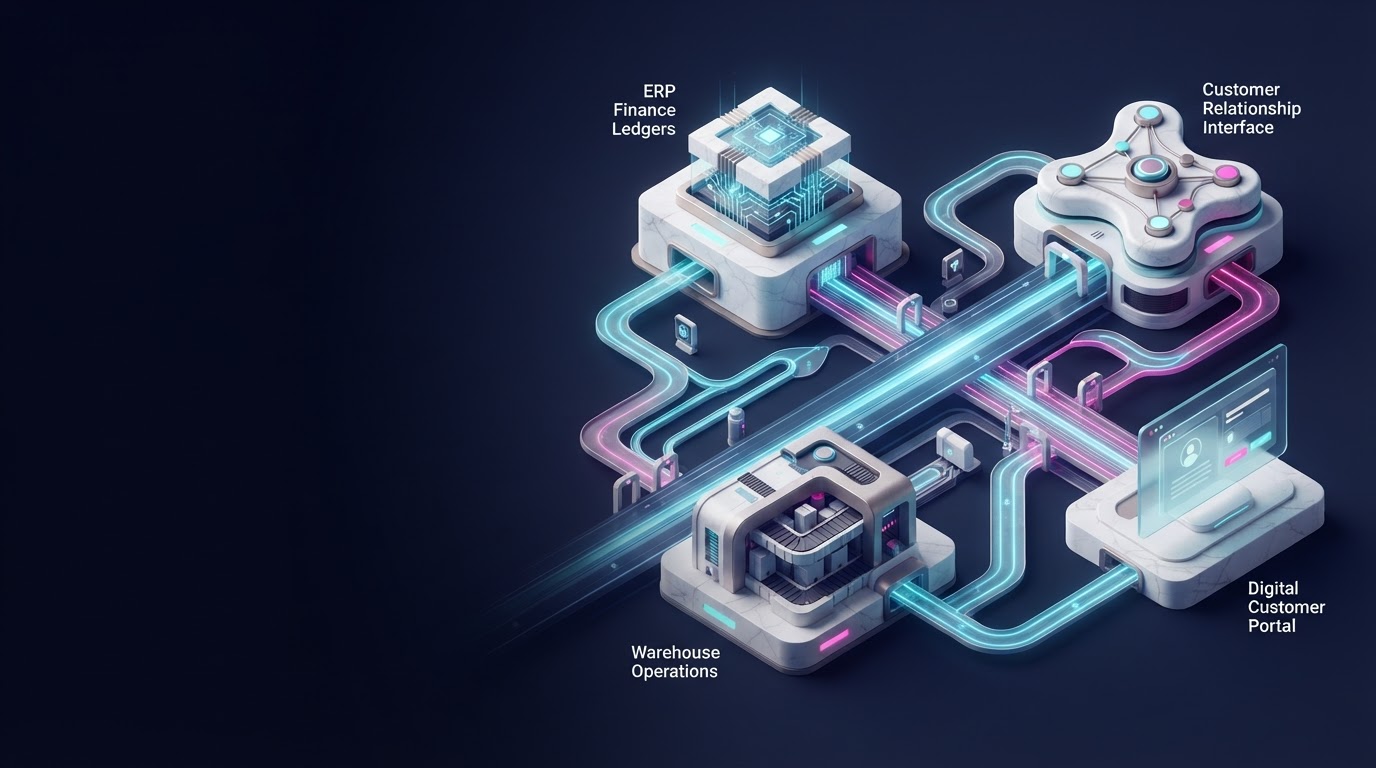
The difference between a capable partner and an expensive lesson comes down to three things: architecture discipline, integration experience, and delivery governance. Enterprise web applications are business-critical systems connecting legacy platforms, cloud services and customer portals into one secure, scalable product.
The market is crowded, so portfolio screenshots tell you little. What matters is how an agency handles data mapping, testing and handover.
Three factors separate a capable enterprise partner from an expensive lesson.
| Factor | What it covers | Why it matters |
|---|---|---|
| Architecture discipline | Composable, API-first design; decoupled, observable, secure systems | Tight coupling locks you into a rebuild |
| Integration experience | Data mapping, testing, repeatable integration patterns | Integration complexity is the usual culprit behind overruns |
| Delivery governance | Artefacts you can audit; risk controls agreed before work starts | Portfolio screenshots tell you little |
Enterprise web application architecture and integration decisions
Architecture is where enterprise web applications succeed or fail. A composable, API-first design lets a customer portal, dashboard and back-end system evolve independently, while tight coupling locks you into a rebuild.
Integration complexity is the usual culprit behind overruns. Teams weighing options should read our explanation of MACH architecture principles and benefits, and if debating service boundaries, review the factors to consider before switching to a microservice architecture.
Integration patterns that hold up under complexity
A capable partner will propose a small set of repeatable patterns rather than bespoke point-to-point links:
- API gateway and facade layers exposing legacy systems through stable, versioned contracts so internal changes do not break portals.
- Event-driven messaging (queue or topic-based pub/sub) for workflows that must survive downstream outages, such as order status updates or claims processing.
- Batch and scheduled synchronisation where near-real-time is unnecessary, often cheaper and easier to reconcile than streaming.
Watch out: an agency that cannot explain how it will handle partial failures, replay and reconciliation will discover those problems during delivery rather than design for them.
Security, identity and data protection by design
Security, access control and data privacy belong in the first architecture workshop, not the last sprint. For enterprise web applications, the baseline usually includes:
- Identity federation using SAML or OpenID Connect, with role-based or attribute-based access control mapped to existing directory groups.
- Secrets management through a dedicated vault rather than configuration files, with rotation policies agreed before go-live.
- Encryption in transit and at rest, plus field-level protection for sensitive health, financial or identity data.
Data residency and sovereignty deserve an explicit decision. Many enterprise buyers expect production data, backups and logs to remain in Australian regions, and some workloads carry contractual or regulatory obligations restricting offshore processing. The architecture should state where each data store, queue and third-party service sits, and how that is enforced rather than assumed.
Scalability and performance mechanisms
Scalability claims are easy to make and hard to verify. Ask which mechanisms the agency intends to use: horizontal scaling behind a load balancer, edge and application-layer caching, read replicas for reporting, asynchronous processing for long-running tasks, and database indexing and query plans reviewed under realistic data volumes. Performance budgets, load testing against production-like data and defined service-level objectives turn scalability into an acceptance criterion.
Compliance and accessibility considerations
Enterprise web applications increasingly sit inside governance frameworks. Privacy Act 1988 and Australian Privacy Principles obligations shape how personal information is collected, stored and disclosed. Accessibility expectations commonly reference the Web Content Accessibility Guidelines, and public-facing or government-adjacent systems may face additional procurement and assurance requirements.
For teams building internal capability, our overview of quality assurance and software testing concepts covers the foundations worth agreeing on before kick-off.
Enterprise software development best practices that reduce delivery risk
Delivery risk drops when discovery, quality assurance and governance are treated as deliverables, not overhead. A structured software development lifecycle with defined testing stages can catch integration faults before deployment, and clear acceptance criteria help limit scope creep.

Governance artefacts that make delivery auditable
Enterprise buyers should expect a predictable set of governance outputs, not just ceremonies:
- A discovery report covering current-state systems, data flows, constraints and a prioritised backlog.
- A decision log recording architecture and scope decisions with rationale and owners.
- A risk register with likelihood, impact, mitigation and review cadence.
Watch out: if governance is described only as weekly status meetings, there is no durable record to support audit, procurement or dispute resolution.
Discovery and stakeholder alignment
A formal discovery phase is the cheapest risk control available. It should confirm business outcomes, success measures, user groups, integration inventory, data quality issues and non-functional requirements such as availability, recovery and performance. Because enterprise applications usually serve several business units with competing priorities, a partner that can run structured workshops, document trade-offs and secure sign-off reduces the chance of mid-project rework.
Legacy migration and data quality
Legacy integration and data migration are where schedules most often move. Practical controls include profiling source data early, defining cleansing and reconciliation rules, running migration rehearsals into staging, and agreeing cut-over and rollback plans with business owners. Where possible, phased migration usually lowers risk compared with a single big-bang release.
Quality assurance and testing depth
Testing should be layered rather than treated as a final gate. Expect unit and integration testing in the build pipeline, automated regression suites for critical journeys, performance and load testing against production-like volumes, security testing, and user acceptance testing with defined entry and exit criteria. Accessibility testing against recognised guidelines should be included where the application serves the public or regulated user groups.
Change management and adoption
Technical delivery alone does not produce outcomes. Change management covers training, communications, support readiness and adoption measurement. A partner should describe how it will prepare affected teams, triage feedback after launch, and measure adoption against the success criteria agreed in discovery.
Post-launch ownership, service levels and intellectual property
Procurement-ready proposals address what happens after go-live: the support model, incident severity definitions and response targets, maintenance windows, escalation paths, and documentation provided.
For teams building internal capability, our overview of quality assurance and software testing concepts covers the foundations worth agreeing on before kick-off. Reviewing our enterprise project examples gives a realistic sense of scope and delivery complexity.
Software development project duration and what drives the timeline
Software development project duration is driven by integration complexity, data migration, security review and stakeholder sign-off, not coding speed. The duration of a focused portal or a multi-system platform with legacy integration depends on the scope and dependencies of the specific project.
Reviewing our enterprise project examples gives a realistic sense of scope and delivery complexity. Expect the timeline conversation to focus on dependencies, because that is where schedules actually move.
Complex enterprise web applications demand a partner who can govern architecture, integration and delivery from discovery through to support. Newpath brings more than 15 years of experience, 200+ creative and technical staff, and full-service capability across custom software development, Drupal platforms, Microsoft technologies and complex integrations.
Frequently Asked Questions
What should enterprise businesses look for in an Australian software development partner?
Look for evidence of complex delivery, not portfolio volume. Ask how the agency handles system integration, data mapping across legacy systems, and access control. Check that architecture and security decisions are documented before build starts, and that quality assurance and deployment are part of the plan rather than an afterthought. Confirm who owns the code and how support works after launch. A partner that can explain its software development lifecycle in plain terms, and show governance suited to procurement, is usually the safer choice for enterprise web applications.
How do Australian agencies handle complex system integrations?
Integration work starts with discovery: mapping data flows between legacy systems, ERP platforms, CRM tools and cloud services before writing code. Agencies typically define API contracts, plan authentication and access control, and stage the rollout so existing business operations are not disrupted. Integration complexity is the main driver of delivery risk on enterprise web applications, so ask for the integration plan in writing and confirm how failures and retries are handled. Testing across connected systems should be scheduled early, not left to the end.
What security and compliance standards should enterprise software meet?
Requirements depend on your sector and data. At minimum, expect authentication, role-based access control, encryption in transit and at rest, audit logging and a documented patching process. Privacy obligations under the Privacy Act 1988 apply to personal information, and government work brings additional procurement and assurance requirements. Ask agencies how they test for vulnerabilities and how they handle incident response. Security should be designed into the application architecture from discovery, not added during deployment.