




Most businesses reach a point where manual processes stop scaling. A sales team copying leads between spreadsheets, an operations manager chasing approvals over email, a finance team rebuilding the same report every month by hand. These are exactly the kinds of gaps that Microsoft Power Platform consulting is designed to close, by turning repetitive, manual processes into automated workflows that run reliably in the background while staff focus on work that actually needs human judgment.
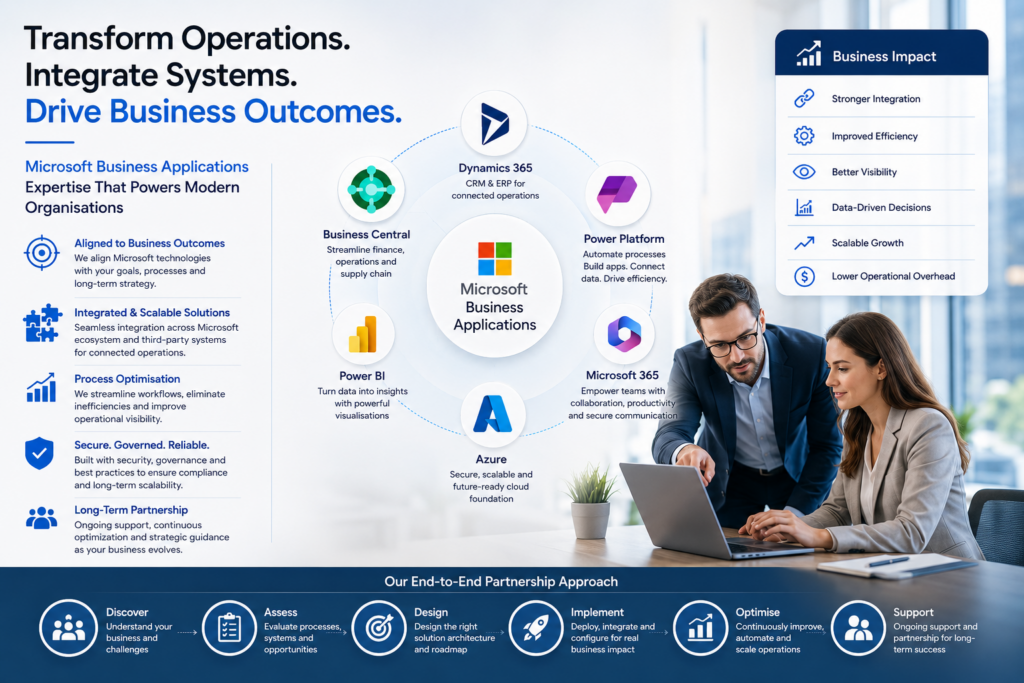
Microsoft Power Platform brings together Power Apps, Power Automate, Power BI, and Copilot Studio into one connected ecosystem, and that combination is exactly why a consultant brings so much value. Rather than treating automation as a single tool to install, a good consultant looks at how a business actually operates and builds a solution that fits, drawing on whichever parts of the platform suit the problem best.
Microsoft Power Platform consulting and why it matters now
Interest in Microsoft Power Platform consulting has grown alongside the platform itself, particularly as Microsoft continues expanding its AI-driven capabilities through Copilot and agent-based automation. Recent platform updates have introduced AI agents capable of handling more complex, multi-step tasks with far less manual configuration than earlier automation tools required. For a business without a dedicated in-house specialist, a consultant brings the knowledge needed to take advantage of these advances properly, rather than letting useful capability sit unused simply because nobody on the team has had time to learn it.
What does a Microsoft Power Platform Consultant do?
The role covers far more ground than simply building a workflow on request. A consultant typically begins by mapping out how work currently moves through a business, identifying where time gets lost to manual handoffs, duplicate data entry, or processes that depend on one person remembering to do something at the right moment. Beyond that, the work typically also covers:
- Building automated workflows in Power Automate that tie systems together and allow actions to occur without manual steps in between
- Creating custom apps in Power Apps to fill the gap when an out-of-the-box tool is just a little bit off from how the business needs to work
- Configuring reporting and dashboards in Power BI so that leadership is empowered by seeing what is really happening (instead of waiting on manually compiled reports)
- Implementing governance structures that keep the automation secure and compliant as additional workflows are added in the future
- Ensuring internal staff are trained so the automation continues to provide value long after the consultant’s initial project has concluded
A consultant also plays a quieter but equally important role in spotting opportunities a business has not yet noticed. Internal teams are often too close to a process to see where it has become inefficient, while an experienced consultant can usually identify the easy wins within the first few conversations.
What is included in Microsoft Power Platform services?
Microsoft Power Platform services typically span the full lifecycle of an automation project, starting with discovery and ending well past initial deployment. Most engagements begin with an assessment of existing systems and processes, followed by a clear plan for which parts of the platform suit which problems.
From there, services generally extend into the build itself, testing to confirm everything performs as expected under real conditions, integration with platforms already in use, such as Dynamics 365 or Microsoft 365, and ongoing support once the solution goes live. Many consultants also offer governance and security setup as a distinct service, since growing automation use across departments can create risk if nobody is actively monitoring how data flows between systems and who has access to it.
What are the responsibilities of a Power Platform Developer?
While a consultant often leads strategy and planning, a Power Platform Developer handles much of the technical build itself. Responsibilities typically include developing custom connectors where a standard integration does not exist, writing more advanced logic within Power Automate flows for scenarios that go beyond simple triggers, and building Power Apps interfaces that are genuinely intuitive for the staff using them daily.
Developers also spend considerable time testing and refining solutions after launch, since real-world use often reveals edge cases that were not obvious during initial design. As Microsoft continues rolling out new platform capabilities, staying current with these updates is also part of the role, ensuring a business’s existing automation keeps pace with what the platform can now do.
Microsoft Dynamics services and the bigger picture
Power Platform rarely operates in isolation from the rest of a business’s Microsoft ecosystem, and this is particularly true for organisations already using Microsoft Dynamics services for sales, finance, or customer management. Power Platform extends Dynamics 365 naturally, allowing automated workflows to trigger directly from CRM data, custom apps to surface Dynamics information in a simpler interface, and dashboards to pull data straight from the system without manual exporting.
For businesses running both, a consultant who understands this connection can build automation that strengthens the existing Dynamics investment rather than duplicating effort elsewhere. The result tends to be a more joined-up system, where information moves smoothly between platforms instead of getting trapped in separate tools that do not talk to each other.
Bringing it all together
Business automation works best when it is built around how a business actually operates, not forced into a generic template. The right Power Platform consultant brings the technical knowledge to build it properly, along with the experience to spot opportunities a business might not have noticed on its own. Newpath Web works with businesses to build exactly this kind of tailored automation, connecting the right parts of the Power Platform to the processes that actually need it. As the platform continues evolving through 2026, with AI playing an increasingly central role across the entire Microsoft ecosystem, that guidance only becomes more valuable for businesses looking to stay ahead.