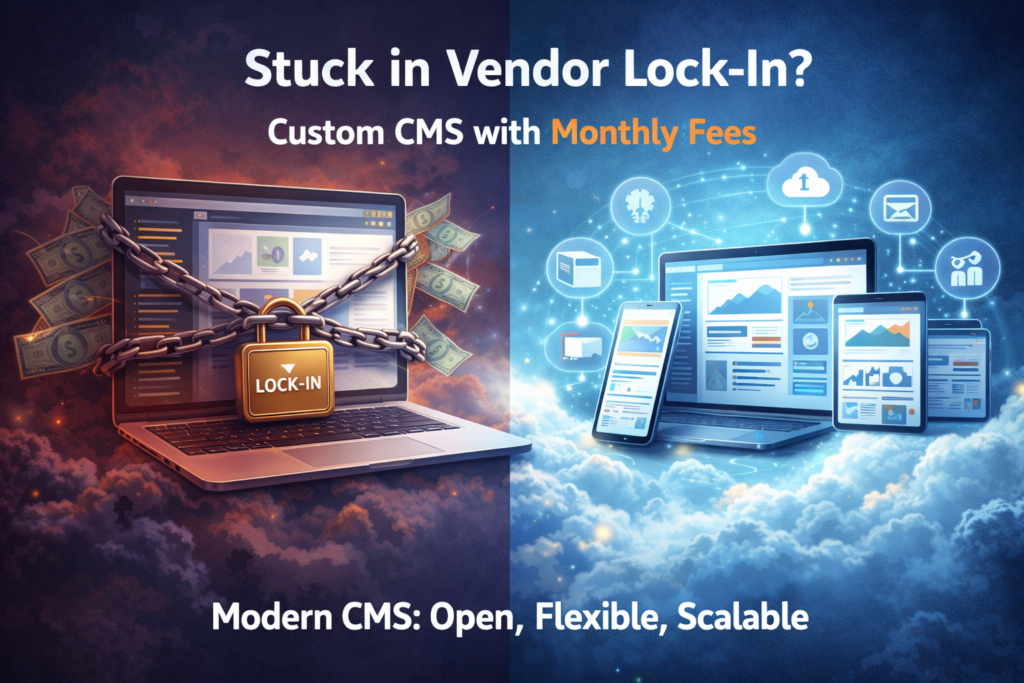





Choosing the right Content Management System (CMS) has never been so critical. In an era of digital-first customer experience, your CMS is the platform on which your brand’s enterprise website, multi-channel publishing, and personalisation are built.
It determines how quickly you can create, manage, deliver and optimise content. It also defines your ability to scale, secure data, and adapt to business needs. Drupal, Kentico, WordPress and a range of other content management platforms each have their strengths. Understanding the role of a CMS in today’s digital landscape and how to evaluate your options is critical to long-term success.
Why Your CMS Choice Matters
A CMS directly influences your digital agility. The right solution:
- Supports consistent brand experiences across channels
- Enables marketing and content teams to operate independently of IT
- Integrates easily with CRMs, ERPs, and eCommerce platforms
- Ensures data protection through robust security features
- Scales with business growth and user demand
In contrast, a poorly chosen CMS can slow time-to-market, introduce technical debt, and limit your ability to personalise content or support complex user journeys.
Popular CMS Platforms at a Glance
Drupal: Drupal is an extremely flexible and scalable solution for companies with complex content architecture, multi-site or multilingual requirements. It is also a favourite of developers for customisation. Choose Drupal if security or advanced structured content modelling is a requirement. For organisations seeking to maximise Drupal’s capabilities, leveraging professional Drupal consulting services can ensure optimal configuration and integration into broader digital ecosystems.
Kentico (Xperience): Kentico provides a hybrid solution that includes both CMS and DXP functionalities. It’s a good choice for organisations looking for out-of-the-box marketing automation, personalisation, and analytics. Its integration-ready architecture also suits mid-to-large businesses seeking to deliver seamless customer experiences across all digital channels.
WordPress: WordPress is one of the most popular CMS in the world, with a great reputation of being user-friendly, which makes it perfect for content-focused websites. It also tends to be a good choice for smaller organisations that need something deployed in a hurry or that will be managed by a non-tech team, as it is known for being very easy to use. With a wide array of plugins and a large community for support, it offers plenty of flexibility, though it often needs more development to meet advanced enterprise needs.
Key CMS Evaluation Criteria: A Business-Centric Checklist
To choose the right CMS, start with a clear understanding of your organisation’s short-term and long-term needs. Use the following checklist to guide your evaluation:
- Content Management Capabilities
- Does the CMS support structured and unstructured content types?
- Can non-technical users easily create, edit, and publish content?
- Is there support for multilingual content and translation workflows?
- Scalability and Performance
- Can the CMS handle traffic spikes and high volumes of content?
- Does it support multi-site architecture?
- Are cloud hosting and containerisation (e.g., Docker, Kubernetes) supported?
- Security and Compliance
- Does the CMS offer robust role-based access control?
- Is there a strong track record of addressing vulnerabilities and issuing patches?
- Does it comply with regulations like GDPR, HIPAA, or WCAG?
- Extensibility and Integration
- Are APIs available for third-party integrations (e.g., CRMs, DAMs, analytics)?
- Does it offer a plugin or module ecosystem for extending core functionality?
- Can it integrate with modern front-end frameworks (React, Vue, etc.)?
- Customisation and Flexibility
- How adaptable is the CMS to unique business workflows?
- Can developers build custom modules or components easily?
- Is the codebase open source or proprietary?
- User Roles and Collaboration
- Does it support content approval workflows and editorial governance?
- Are there customisable dashboards or user experiences for different teams?
- SEO and Digital Marketing Support
- Are SEO tools like schema markup, URL customisation, and metadata editing built in?
- Is there support for A/B testing and content personalisation?
- Does it integrate with marketing automation platforms and email services?
- Maintenance and Support
- What level of vendor or community support is available?
- Are updates and upgrades frequent and manageable?
- Is there documentation and training for both developers and content teams?
- Total Cost of Ownership (TCO)
- What are the licensing fees, if any?
- How much development and maintenance effort will be required?
- Is hosting included, or must it be provisioned separately?
Planning for the Future: Building with Flexibility
Your CMS should be able to power innovation as your tech stack changes. Is a 2021 tech stack about the personalisation engines that utilise AI, or becoming a headless CMS and building your brand experience across channels and devices, or creating content experiences for the rapidly emerging IoT? You should have a CMS built on modular, future-proof platforms.
Drupal is a great choice for organisations prioritising structured content, strict security, and large-scale content delivery, while Kentico is a top choice for enterprises and agencies prioritising an all-in-one DXP with limited technical involvement. WordPress will always be a leader in 2021 and the go-to solution for its low-cost/rapid content publishing and scaling, depending on project needs.
One way to cut through the noise is to stop discussing the most popular platforms and start thinking about the best-fit platforms.
A CMS is a strategic technology platform and a significant driver in helping an organisation meet its digital strategy. The CMS you choose impacts everything from marketing and business agility to developer efficiency and resilience. It’s also one of the biggest opportunities to arm your teams, future-proof your digital experience, and differentiate your customer experience.
Our advice for enterprises evaluating their CMS portfolio or looking for a migration partner in 2021 and beyond: Consider partnering with an agency partner with a strong track record, whether a Drupal consulting services company or a multi-platform digital agency, to increase speed to success, limit risk, and drive value for the long term.