



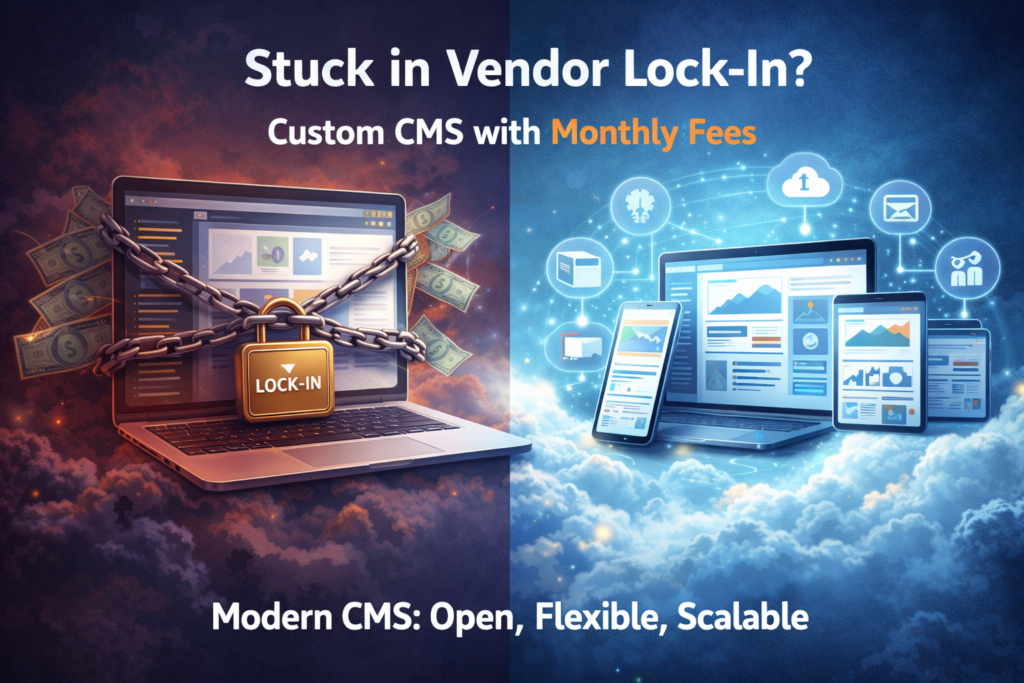

Across industries, we continue to see a recurring pattern.
Large organisations, many with sophisticated digital ambitions, are operating on custom-built CMS platforms that were developed years ago. These platforms are typically owned and controlled by the agency that built them, with ongoing monthly fees attached for hosting, support, and even basic content changes.
On the surface, this can appear manageable.
Underneath, it represents one of the most significant structural risks in modern digital environments.
Vendor lock-in at the CMS level is not just a technical inconvenience. It is a commercial constraint, a strategic limitation, and increasingly, a barrier to growth.
For CIOs and CMOs, this is a problem that demands attention.
How we got here
Custom CMS platforms were not always a poor decision.
In the early days of digital, off-the-shelf platforms were limited. Organisations with complex requirements often needed bespoke solutions to achieve their objectives. Agencies responded by building proprietary systems tailored to specific clients.
At the time, this made sense.
But the market has evolved significantly.
Today, enterprise-grade CMS platforms are mature, flexible, and highly extensible. Open ecosystems, API-driven architectures, and composable approaches have changed what is possible.
Despite this, many organisations remain tied to legacy custom platforms that no longer align with modern requirements.
The illusion of control
One of the reasons custom CMS platforms persist is the perception of control.
On paper, a bespoke system suggests ownership. It feels tailored, unique, and aligned to the organisation’s needs.
In reality, the opposite is often true.
Most custom CMS platforms are tightly coupled to the agency that built them. The codebase is proprietary. Documentation is limited. Knowledge sits with a small number of developers, often outside the organisation.
This creates a dependency that is difficult to unwind.
The organisation does not control the platform. The vendor does.
The commercial model behind lock-in
The commercial structure of these platforms is where the real issue emerges.
Typically, organisations are paying:
- ongoing hosting fees
- monthly support retainers
- additional charges for enhancements or changes
- licensing-style costs embedded in service agreements
At the same time, they are unable to extract meaningful value from that spend.
Why?
Because the platform itself is not transferable.
If the organisation chooses to leave, they do not take the system with them. They start again.
This creates a scenario where switching costs are artificially high, not because of complexity, but because of how the platform has been structured.
From a commercial perspective, this is not a partnership. It is a containment strategy.
The impact on marketing and growth
For CMOs, the implications are significant.
Modern marketing relies on agility. Campaigns need to be launched quickly. Content needs to be updated in real time. Personalisation, experimentation, and optimisation are now standard expectations.
Custom CMS platforms often struggle to support this.
Common limitations include:
- slow turnaround for content changes
- rigid templates and page structures
- limited integration with marketing tools
- lack of scalability for new channels
This creates friction at every stage of the marketing lifecycle.
Instead of enabling growth, the platform becomes a bottleneck.
Over time, this leads to missed opportunities, slower execution, and reduced competitiveness.
The impact on technology strategy
For CIOs, the problem runs deeper.
Custom CMS platforms are rarely built with modern architectural principles in mind. They are often monolithic, tightly coupled, and difficult to integrate with other systems.
This creates challenges around:
- system interoperability
- data flow and visibility
- security and compliance
- scalability and performance
As organisations move toward composable architectures and API-driven ecosystems, these platforms become increasingly isolated.
They do not fit.
The result is a fragmented technology landscape, where core systems cannot communicate effectively, and innovation is constrained by legacy decisions.
The cost of standing still
One of the most dangerous aspects of vendor lock-in is that it is often tolerated.
The platform works, at least at a basic level. The cost is predictable. The risk of change feels high.
So organisations stay.
But standing still has a cost.
While the organisation remains constrained, competitors are moving forward. They are adopting modern platforms, improving user experiences, and integrating their systems more effectively.
The gap widens over time.
What was once a manageable limitation becomes a strategic disadvantage.
What modern CMS platforms look like
The alternative is not simply “moving to a different CMS”.
It is adopting a fundamentally different approach to digital platforms.
Modern CMS environments are:
- platform-agnostic
- API-driven
- modular and composable
- designed for integration
They separate content management from presentation, allowing organisations to deliver content across multiple channels without being constrained by a single system.
They support:
- seamless integration with CRM, marketing automation, and analytics platforms
- scalable content delivery across web, mobile, and emerging channels
- faster development cycles and greater flexibility
Most importantly, they reduce dependency on any single vendor.
Reclaiming control
Moving away from a custom CMS is not just a technical exercise. It is a strategic decision.
It requires organisations to:
- assess their current platform objectively
- understand the true cost of their existing model
- define a clear vision for their digital ecosystem
This process often reveals that the perceived complexity of migration is outweighed by the long-term benefits.
Reclaiming control means:
- owning your data
- owning your content
- owning your platform direction
It means being able to choose partners based on value, not necessity.
A more sustainable model
The goal is not to eliminate external partners. Strong agency relationships remain critical.
But the model needs to change.
Instead of being locked into a single vendor, organisations should operate within an ecosystem where:
- platforms are open and extensible
- partners can be changed without rebuilding the entire system
- costs are aligned to value, not dependency
This creates a more balanced, sustainable approach to digital delivery.
Practical steps forward
For organisations currently operating on custom CMS platforms, the first step is awareness.
Ask the following questions:
- Can we move our platform to another provider without rebuilding it?
- Do we have full access to our codebase and documentation?
- How long does it take to make meaningful changes?
- Are we constrained in how we integrate with other systems?
If the answers raise concerns, it is time to evaluate alternatives.
From there, focus on:
- defining future requirements
- assessing modern CMS platforms
- planning a phased migration strategy
This does not need to be disruptive. With the right approach, it can be managed in a controlled, incremental way.
Closing perspective
Custom CMS platforms built around vendor lock-in belong to a previous era of digital.
They were created in a different context, with different constraints.
Today, they represent a risk.
For CIOs and CMOs, the challenge is not just technical. It is strategic.
It is about ensuring that your digital foundation supports your organisation’s growth, rather than limiting it.
Because in a landscape defined by speed, flexibility, and integration, the ability to adapt is not optional.
And platforms that prevent that are no longer fit for purpose.