




Digital transformation rarely fails because an organisation chose the wrong technology. It fails because the technology wasn’t implemented to match how the business actually operates. Microsoft Dynamics 365 is one of the most powerful platforms available for connecting business operations, customer relationships, and financial management, but its value is directly tied to the quality of its implementation. That’s where a Microsoft Dynamics 365 crm solution partner becomes critical. These consulting services exist to bridge the gap between what the platform can do and what a specific organisation needs it to do.
What a Microsoft Dynamics 365 CRM solution partner actually delivers
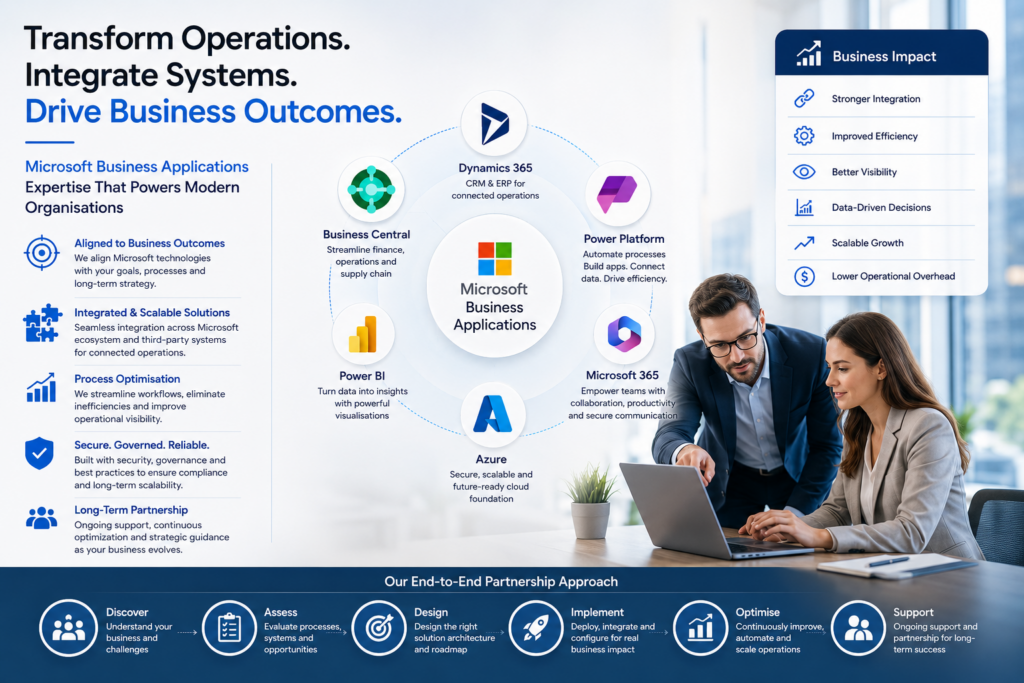
Dynamics 365 consulting is not a single service; it’s a comprehensive engagement that encompasses the full lifecycle of a platform implementation. This generally involves software selection, business assessments, improvement roadmaps, business case development, migration planning and execution, among other components.
Before configuration work even begins, an expert consulting team is there to discover the business processes, the key pain points, and the quantifiable goals of the organisation. The discovery phase guides which modules are required, the data mapping between them, and the integration needs that will help it all connect to the existing technology ecosystem.
From there, the engagement moves through design, build, testing and deployment, and then on to training, change management support, and continuous optimisation. The most effective consultants bring both technical capability and business consulting skills to drive not only a functioning system, but also real operating value and organisational adoption.
What are the different modules in Microsoft Dynamics 365?
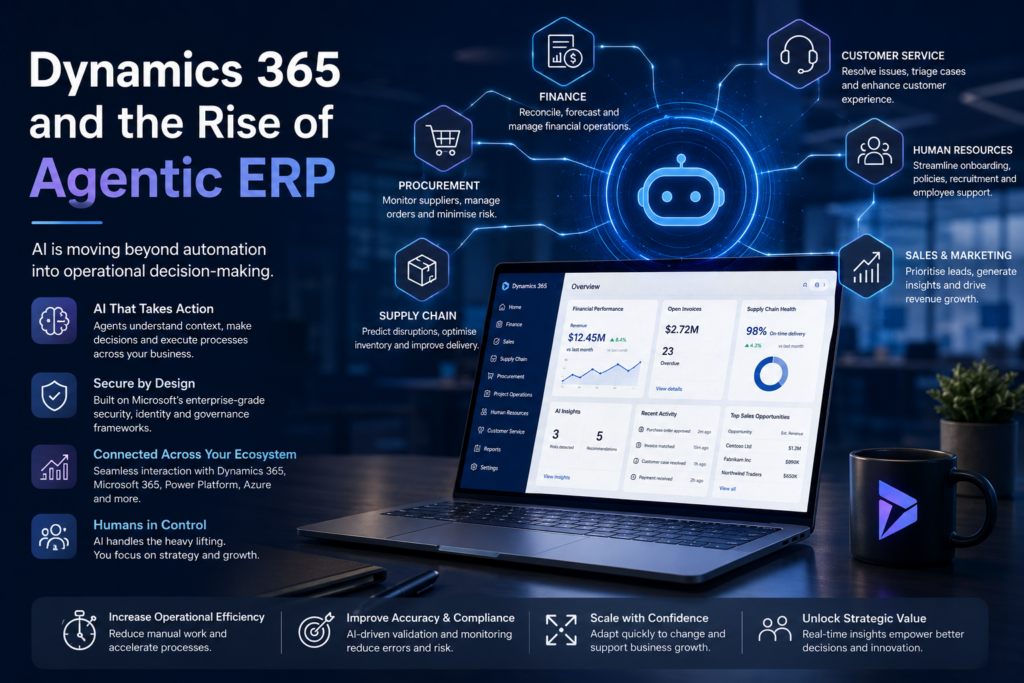
Dynamics 365 is a suite of more than 15 enterprise cloud applications built on a common platform, each focused on a discrete set of business challenges spanning financial management, supply chain optimisation, customer relationship management, and AI-powered insights and analytics.
Microsoft groups these into five broad application areas: Finance and Operations for accounting, supply chain, and manufacturing; Customer Engagement for sales, service, field operations, and marketing; Human Capital Management for recruiting, payroll, and talent; Intelligent Engagement and Insights for AI-powered analytics; and Specialised Solutions, which includes contact centre, fraud protection, and mixed reality applications.
Key modules most often deployed in practice by organisations are:
- Dynamics 365 Sales: pipeline management, lead tracking, opportunity forecasting, and sales workflow automation
- Dynamics 365 Customer Service: case management, SLA tracking, knowledge base, and omnichannel support
- Dynamics 365 Finance: core accounting, budgeting, fixed assets, cash management, and financial reporting
- Dynamics 365 Supply Chain Management: procurement, inventory, warehouse operations, manufacturing, and demand planning
- Dynamics 365 Business Central: an all-in-one ERP solution for SMBs that includes finance, operations, and customer management
- Dynamics 365 Project Operations: end-to-end project lifecycle management from quoting and resourcing through to billing
What does a Dynamics 365 consultant do?
A Dynamics 365 consultant is involved in technical and organisational tasks. At the beginning of a project, they lead requirements gathering workshops with stakeholders, map existing business processes, identify gaps and translate them into a functional design for the platform. In their role, consultants work closely with clients to understand their business processes, gather requirements and develop solutions that maximise the platform’s use. They have accountability for practical delivery within agreed-upon timeframes and budget, including testing and quality assurance, coordinating user acceptance testing, end-user training and change management to transition from legacy systems.
For more complex projects, they also collaborate with solution architects and developers to ensure that customisations and integrations align with functional requirements and technical best practices. After a solution goes live, they are responsible for monitoring performance, troubleshooting issues and providing support, as well as looking for opportunities to expand the platform’s value as the organisation’s needs grow.
The role of a Power Platform functional consultant
In environments where Dynamics 365 is part of a wider Microsoft ecosystem, a Power Platform functional consultant provides a specialist role. They are responsible for eliciting business requirements and designing solutions using Power Automate, Power Apps and Power BI, to automate workflows, build custom applications and analyse data to help optimise business processes across the enterprise.
A Power Platform functional consultant will be able to take those core capabilities a step further by building automation flows that connect Dynamics to other business systems, developing lightweight apps to address specific operational needs, and constructing reporting dashboards that surface meaningful data for decision-makers.
This is where D365 Azure integration is particularly relevant. By ensuring that the platform integrates seamlessly with Microsoft 365, and by leveraging the scalability and security of the Azure platform, Dynamics 365 becomes part of a comprehensive, flexible and future-proof business solution. Azure services can be utilised to enable advanced scenarios that include cloud-based data storage and retrieval, API management, identity and access control, and AI model deployment, all of which can be integrated with the platform to augment what it delivers out of the box.
Why working with Microsoft Dynamics partners in Australia matters
The quality of implementation is by far the most important factor in a Dynamics 365 project. The platform is extremely flexible, which can be a double-edged sword. A poorly scoped or under-resourced implementation can easily result in a system that may technically work but which ultimately does not deliver value to the business.
Working through accredited partners enables the team to prove expertise and competency across the breadth of the platform’s applications, utilise the Microsoft implementation standards and leverage the support and product roadmap visibility which is simply not available to independent consultants. For Australian companies, local partnership also provides benefits in relation to understanding local compliance and data sovereignty requirements, as well as the specific operational contexts of industries such as financial services, professional services, government and construction.
An experienced consulting partner can offer extensive support and hands-on guidance, in order to help organisations take full advantage of Microsoft’s ERP and CRM functionality to drive growth and mitigate risk to their investment. It is that combination of technical and business knowledge which distinguishes a successful Dynamics 365 implementation from one which underperforms its potential.