



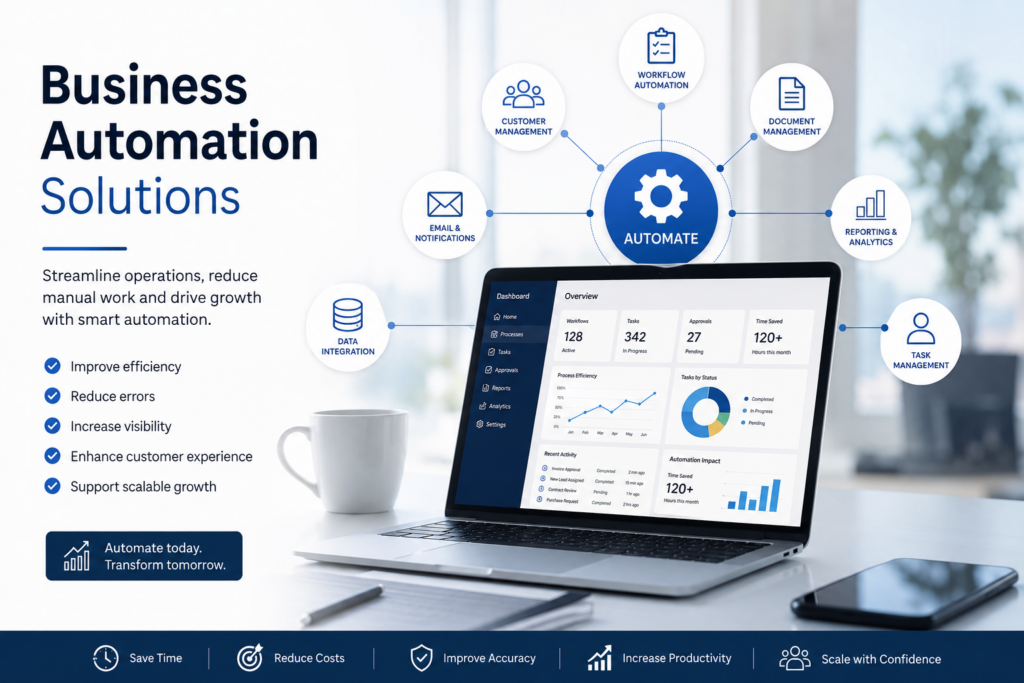

Across nearly every industry, organisations are under pressure to improve efficiency, reduce operational overhead and respond faster to changing customer expectations.
At the same time, many businesses are still heavily reliant on:
- manual processes
- disconnected systems
- duplicated administration
- spreadsheets
- email-driven approvals
- siloed data
These operational inefficiencies create unnecessary friction, slow decision-making and limit scalability.
Business automation solutions help organisations streamline operations, improve visibility and reduce repetitive manual work across core business functions.
For many organisations, automation is no longer simply a productivity initiative. It has become a critical part of digital transformation and long-term operational strategy.
What Are Business Automation Solutions?
Business automation solutions use software, workflows and system integrations to automate repetitive or rule-based business processes.
These automations may include:
- approval workflows
- lead management
- onboarding processes
- document generation
- customer communications
- invoice processing
- reporting and analytics
- support ticket management
- CRM workflows
- data synchronisation
- project notifications
- internal task routing
The goal is not simply to replace manual work, but to improve consistency, visibility and operational scalability.
The Growing Cost of Manual Processes
Many businesses underestimate the operational cost of manual workflows.
Manual processes often lead to:
- duplicated effort
- inconsistent data
- delayed approvals
- reduced productivity
- increased human error
- poor reporting visibility
- staff frustration
- slower customer response times
These inefficiencies compound over time as organisations grow.
Processes that once worked adequately for a smaller business often become unsustainable as operational complexity increases.
Why Automation Has Become More Accessible
Historically, automation projects required large custom software investments and lengthy development cycles.
Modern platforms have significantly changed this landscape.
Technologies such as:
- Microsoft Power Platform
- Dynamics 365
- Azure integrations
- workflow automation tools
- API-driven platforms
- low-code development environments
…now allow organisations to automate processes far more quickly and cost-effectively.
This has made automation accessible to mid-sized businesses that previously lacked the budget or technical resources for large-scale custom development.
Business Automation Is About More Than Cost Reduction
Although automation often reduces operational costs, the broader value lies in improving organisational capability.
Effective automation can help businesses:
- improve customer experience
- increase operational visibility
- accelerate service delivery
- improve compliance
- strengthen reporting accuracy
- reduce operational risk
- support remote teams
- improve scalability
Automation allows teams to focus on higher-value work rather than repetitive administration.
Common Areas for Business Automation
Sales and CRM Workflows
Many organisations automate:
- lead assignment
- follow-up reminders
- proposal generation
- customer onboarding
- sales notifications
- opportunity tracking
These workflows improve responsiveness while reducing administrative overhead.
Finance and Operations
Automation is increasingly used across:
- invoice approvals
- procurement processes
- payment workflows
- expense management
- reporting distribution
This improves operational consistency and reduces delays.
Customer Service
Customer support automation may include:
- ticket routing
- escalation management
- automated responses
- service notifications
- knowledge base integration
These automations improve service delivery while reducing support workload.
HR and Employee Processes
Businesses often automate:
- employee onboarding
- leave approvals
- policy acknowledgements
- recruitment workflows
- internal requests
This creates more efficient internal operations.
Microsoft Power Platform and Business Automation
Microsoft Power Platform has become one of the most widely adopted automation ecosystems due to its flexibility and integration capability.
Power Platform includes:
- Power Automate
- Power Apps
- Power BI
- Copilot capabilities
These tools allow organisations to:
- automate workflows
- build internal business applications
- improve reporting visibility
- connect existing systems
- streamline manual operations
For businesses already operating within the Microsoft ecosystem, Power Platform can significantly accelerate automation initiatives.
Integration Is Critical to Successful Automation
One of the most important aspects of business automation is system integration.
Many businesses operate across multiple platforms including:
- CRM systems
- ERP systems
- finance platforms
- HR systems
- websites
- customer portals
- cloud applications
Without integration, automation remains fragmented.
Effective business automation solutions connect systems to create unified operational workflows and centralised visibility.
Automation Should Support Business Strategy
One of the biggest mistakes organisations make is automating inefficient processes without first evaluating whether those processes should exist in their current form.
Successful automation projects begin with:
- process review
- workflow simplification
- operational analysis
- business objective alignment
Automation should improve operations, not simply accelerate inefficiency.
The Importance of Scalability
Business automation should support long-term growth.
Poorly designed automation can create:
- maintenance complexity
- technical debt
- brittle workflows
- difficult integrations
- scalability limitations
Organisations should prioritise automation solutions that are:
- maintainable
- flexible
- secure
- scalable
- aligned with broader technology strategy
Choosing the Right Automation Partner
Successful automation projects require both technical capability and operational understanding.
Businesses should look for automation partners with experience in:
- process optimisation
- systems integration
- business analysis
- workflow design
- Microsoft technologies
- custom development
- change management
Technology expertise alone is rarely sufficient.
The best automation partners understand how businesses actually operate.
Looking Ahead
Business automation solutions are rapidly becoming a core component of modern operational strategy.
As organisations face increasing pressure to improve efficiency and scalability, automation provides opportunities to reduce friction, improve visibility and support long-term growth.
The businesses achieving the strongest outcomes are not simply automating tasks.
They are redesigning operations around connected, scalable digital processes.