




Businesses looking into Microsoft Power Platform consulting often start with the same question: what does this actually cover? It’s a fair question, since Power Platform isn’t a single product. It’s a connected suite of tools, and the services built around it can vary a fair bit depending on who you’re talking to and what your business actually needs.
Below, we’ve broken down exactly what’s typically included, how it connects to the wider Microsoft ecosystem, and what a good Power Platform partner should actually be doing for you.
What is Microsoft Power Platform consulting?
At its core, Microsoft Power Platform consulting covers the strategy, planning, and hands-on work needed to help a business get real value out of Power Apps, Power Automate, Power BI, and Power Pages. Rather than just handing over a licence and hoping for the best, a proper consulting engagement starts by understanding what’s actually slowing your business down, whether that’s manual data entry, disconnected systems, or reporting that takes days to pull together.
From there, consulting typically covers a few core stages: assessment of current processes, solution design, build and implementation, integration with your existing systems, and ongoing training and support once everything’s live. Good consulting doesn’t stop at launch. It’s about making sure the solution keeps delivering value as your business changes.
What is included in Microsoft Dynamics services alongside Power Platform?
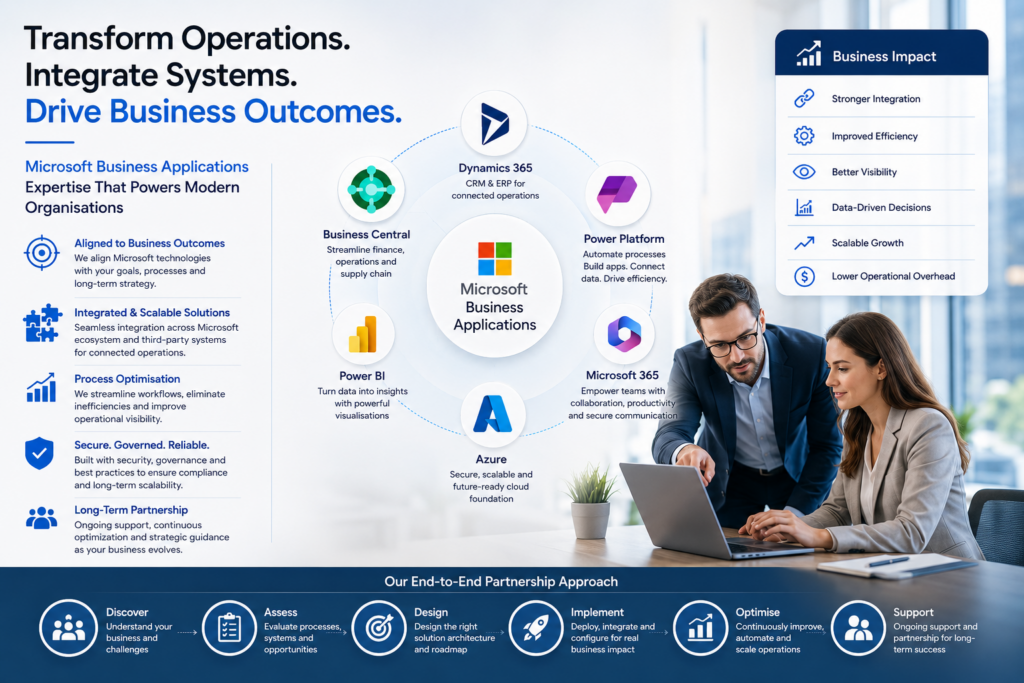
Power Platform doesn’t exist in isolation, and for a lot of businesses, it works hand in hand with Microsoft Dynamics services. Dynamics 365 covers a business’s core CRM and ERP functions, sales, customer service, finance, and operations, while Power Platform provides the flexible layer on top that lets you extend, customise, and automate around that core system.
In practice, this might mean building a Power App that gives field staff mobile access to Dynamics data, or using Power Automate to trigger workflows automatically when a record changes in Dynamics 365. Power BI can then pull that same data into live dashboards for leadership, without needing a separate reporting tool bolted on the side. Power Pages can even extend that same data out to external users, customers or partners through a secure, branded portal rather than a clunky email chain. When Power Platform and Dynamics services are planned together properly, the whole system works as one connected environment rather than a patchwork of separate tools that all need their own maintenance and support.
What do Microsoft Power Platform developers actually build?
Microsoft Power Platform developers are the ones turning strategy into something your team can actually use day-to-day. That typically includes Canvas Apps and Model Driven Apps built with Power Apps, automated workflows through Power Automate, external-facing portals through Power Pages, and interactive reporting dashboards through Power BI.
Developers work closely with Microsoft Dataverse, the data backbone connecting these tools together, ensuring everything from a mobile inspection form to an executive dashboard is pulling from the same, accurate, governed source of data rather than scattered spreadsheets.
What are the responsibilities of a Power Platform Developer?
This is one of the most common questions businesses ask before bringing a developer on board, and it’s worth answering clearly. A Power Platform Developer’s responsibilities generally include:
- Analysing existing business processes to identify where automation or a custom app would genuinely save time
- Designing and building solutions using Power Apps, Power Automate, Power BI, and Dataverse
- Setting up proper governance, ensuring solutions meet security, compliance, and data handling standards
- Integrating Power Platform solutions with other systems, including Dynamics 365, SharePoint, and third-party platforms
- Testing and refining solutions to make sure they actually hold up under real-world, day-to-day use
- Training internal teams and supporting adoption once a solution goes live, so it actually gets used rather than sitting unused
A skilled developer isn’t just writing configuration, they’re making judgement calls about which tool actually fits a specific business problem, and building something that’s genuinely maintainable long after the initial project wraps up. That last point matters more than it might seem. A poorly documented app with no governance behind it can quickly become just as much of a headache as the manual process it replaced.
How does training and support fit into Power Platform services?
A Power Platform solution is only as good as the team using it, which is why training and ongoing support are usually built into a proper service offering rather than treated as an afterthought. This typically covers role-based training for different user types, clear documentation, and a support arrangement to troubleshoot issues or make adjustments as business needs evolve.
This is also where genuine Microsoft Power Platform development solutions tend to separate themselves from a quick, one-off build. A solution designed with proper governance, documentation, and support behind it keeps delivering value for years, rather than becoming another unused app within a few months of launch.
Why work with Newpath Web for your Power Platform project?
At Newpath Web, we bring together the strategic thinking, technical development, and ongoing support businesses actually need to get real value from Power Platform, not just a demo that looks good in a sales pitch. Our team works across the full Microsoft ecosystem, including Dynamics 365, SharePoint, and Azure, so your Power Platform solution genuinely connects with the systems your business already relies on.
Whether you’re looking to automate a manual process, build a custom app for your team, or bring your data together into clear, actionable reporting, Newpath Web can help scope the right approach for your business and build something that actually lasts.
If you’re weighing up where Power Platform could genuinely help your business, the best next step is a proper conversation about your specific processes and goals, not a generic sales pitch. Reach out to Newpath Web to talk through what a tailored Power Platform solution could look like for your team.