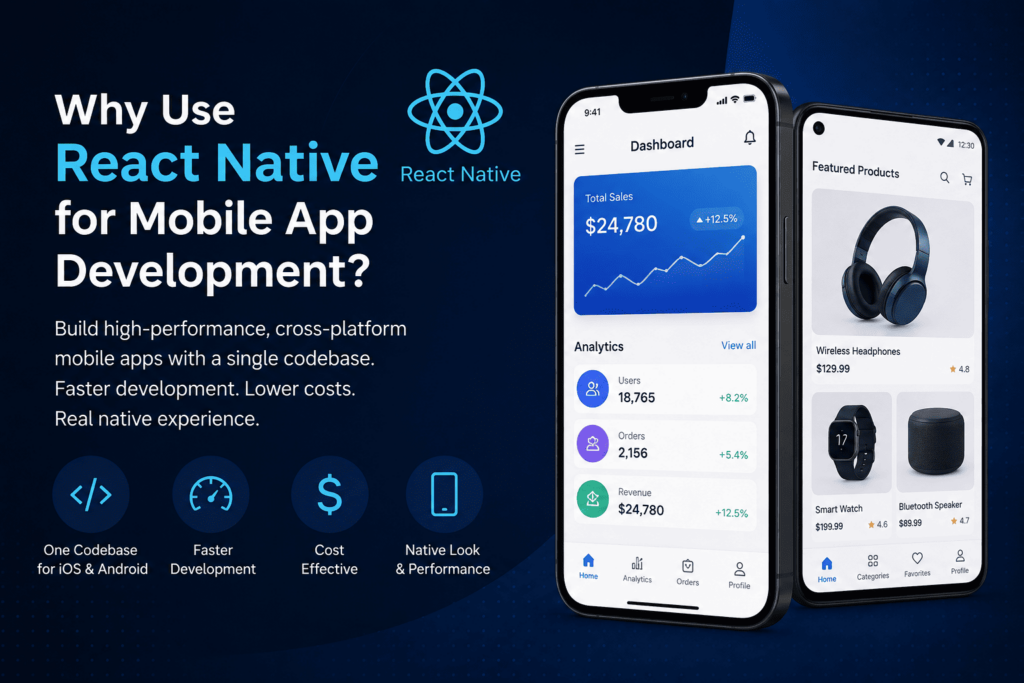





A business deciding how to build its mobile app usually faces the same fork in the road early on. Build separate native apps for iOS and Android, or build one app that runs on both. Teams working on React Native app development in Australia increasingly choose the second path, and the reasons go well beyond simply saving time. React Native lets a single codebase power both platforms while still rendering genuine native components, not a web view dressed up to look like an app. That distinction matters more than it sounds, because it shapes everything from how the app performs to how much it costs to maintain over the years ahead.
Why React Native app development in Australia continues to grow
Interest in this approach has grown steadily as more businesses recognise that building twice, once for iOS and once for Android, rarely makes sense unless an app has very specific technical demands. The framework has matured well past its early reputation for compromise, and most standard business apps now run smoothly without the performance trade-offs that once worried developers.
What is React Native cross-platform development consulting?
Selecting a framework is only the first step. After that, most companies need assistance in putting it to effective use, which is where cross-platform development consulting services come in. A consultant will evaluate the goals of the business, the intended users of the end product, and what platform-specific features the app actually needs, then devise a strategy that leverages the strengths of React Native while avoiding the things it cannot do.
Consulting in this area will typically address a few key questions. It will help decide which components of the application can share 100% of their code, and which must be tailored to the nuances of each platform, help configure a testing and deployment pipeline for both app stores, and set up the project so that it will continue to be easy to maintain as the framework continues to evolve. Technical decisions taken at the beginning of a build will tend to define every decision that follows, so this phase is more important than it may initially seem.
Why is React Native used for mobile app development?
These reasons are still valid today, even as React Native has evolved significantly since first capturing developers’ imaginations. With a single codebase, only one team needs to build for both platforms instead of two separate apps, reducing both development time and the long-term cost of maintaining bug fixes and updates. Architectural changes have also shrunk the performance gap, which used to be a major drawback for the framework and deterred developers from considering it for anything but basic apps. Here are a few other pragmatic reasons for businesses to stick with it:
- A single shared codebase both reduces build time and simplifies long-term maintenance, since a fix or feature change typically only needs to be written once
- Hot reloading can display code changes instantly without reloading the whole app, making testing faster and shortening the feedback loop during development
- Rendering native UI components instead of emulating them keeps apps feeling responsive and platform-native
- A large, active community means most common problems have existing solutions, which saves time debugging without requiring teams to reinvent the wheel
- Team members can easily transfer existing React skills from web development, simplifying both hiring and team scaling as a project expands
Working with a web development agency in Melbourne that businesses can trust
Building a great React Native app isn’t just a technical challenge. It needs a team that is invested in the business the app serves, and the users it serves. That’s why the web development agencies you call upon for this work will have experience of not just the mobile build itself, but the entire ecosystem surrounding it. A web development agency in Melbourne that businesses turn to for this kind of work typically brings experience across both the mobile build and the surrounding ecosystem, including how the app fits alongside an existing website or internal systems.
This is a big deal because an app doesn’t usually exist in isolation. It needs to connect to a content management system, booking or payment platform, or any internal business systems already running. A team that knows the full picture will make decisions early in the process to avoid expensive rework later on. Rather than treating the app as a standalone piece that sits apart from everything else the business uses or runs on.
React native enterprise app solutions for growing organisations
Smaller apps benefit from React Native’s speed, but larger organisations have different concerns entirely. React native enterprise app solutions need to handle larger user bases, integrate with existing internal systems, and meet stricter security and compliance requirements, all without sacrificing the development efficiency that made React Native attractive in the first place.
The framework has matured to a point where it genuinely supports this kind of scale. Modular architecture allows large development teams to work on different parts of an app simultaneously without constant conflict, and the same component based approach that benefits a small app scales naturally as more features and screens get added. For enterprises already running React-based web applications, code patterns and even some business logic can often carry across from the web platform into the mobile app, rather than starting from a blank page.
Choosing the right partner for the build
The technical case for React Native is strong, but the outcome of any project still depends heavily on who builds it. Newpath Web focuses on exactly this kind of work, building React Native apps that are configured properly from the start rather than patched together under deadline pressure.
For any business comparing website development solutions in Melbourne, the deciding factor usually isn’t the framework itself. It’s whether the team behind it understands how to use it properly, on a platform that, by 2026, has proven itself well beyond the early scepticism it once attracted.