



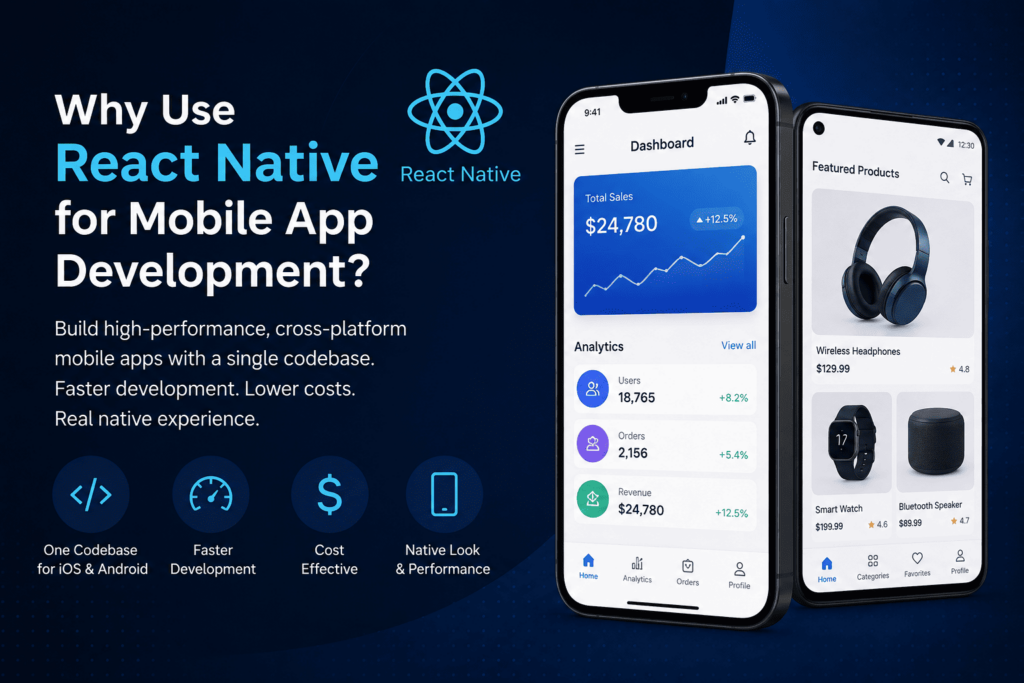

If you’re weighing up your options for building a mobile app, you’ve probably come across React Native more than once in your research. There’s a good reason for that. It’s become one of the most widely used frameworks for building apps that work smoothly across both iOS and Android, without needing two separate development teams working on two separate codebases. For businesses exploring react native development for startups, that combination of speed, cost efficiency, and genuine app quality is exactly why it keeps coming up as the recommended option.
Below, we’ve answered the questions we get asked most often about React Native, what it actually does well, where its limits are, and how to know if it’s the right fit for your next project.
What is react native mobile app development?
This is the process of building mobile apps using a single JavaScript and TypeScript codebase that runs on both iOS and Android, rather than building two entirely separate native apps in Swift and Kotlin. Originally developed by Meta, React Native bridges the gap between web-style development and genuinely native app performance, giving businesses near native results without the cost of maintaining two parallel development teams.
This matters more than it might sound. Building and maintaining two completely separate codebases means double the development time, double the testing, and double the ongoing maintenance every time a feature gets updated. React Native removes a lot of that duplication while still delivering an app that looks and feels properly native to the user.
Why react native development for startups makes sense
Startups tend to face a very specific set of pressures: limited budget, tight timelines, and the need to get a product in front of real users as quickly as possible to start gathering feedback. React Native was designed to function well in precisely this kind of context.
Compared to creating two native apps from scratch, a single development team may work for both platforms concurrently, greatly reducing development time and expense. In addition to saving money up front, this efficiency allows updates and new features to be released simultaneously to both platforms instead of having to be developed and tested twice. For a startup trying to iterate quickly based on user feedback, that speed can make a genuine difference to how fast the product actually improves.
Can React Native handle large-scale enterprise applications?
This is one of the most common concerns businesses raise, and it’s a fair one to ask. The short answer is yes. Since its inception, React Native has developed significantly, and in recent years, its architecture has been specifically enhanced to manage intricate animations, data-rich interfaces, and resource-intensive processes without appreciable performance loss.
A true tribute to how far the framework has come as an enterprise-ready alternative is the fact that some of the biggest organisations in the world, such as Microsoft, Tesla, Bloomberg, and Walmart, operate production React Native apps servicing millions of users. For larger organisations, success tends to depend less on the framework itself and more on working with developers who understand how to structure a React Native app properly for scale, including security, offline functionality, mobile device management, and integration with existing enterprise systems and legacy platforms.
What is React Native cross-platform development consulting?
React Native cross-platform development consulting covers the strategic and technical guidance businesses need before, during, and after a build, helping ensure the right approach is chosen from the start rather than discovered as a problem partway through the project. This usually entails determining whether React Native is actually the best choice for your particular application, appropriately designing the architecture for the scale you anticipate, and directing choices around backend infrastructure, integrations, and long-term maintainability.
Good consulting also helps businesses avoid a common trap, treating React Native as a shortcut rather than a proper engineering discipline. Getting real value from the framework still requires experienced developers who understand its strengths and its limitations, and who can make sound architectural decisions early rather than needing costly rework later.
How does react native development fit into a broader website development services offering?
For a lot of businesses, a mobile app doesn’t exist in isolation, it needs to work alongside a website, a customer portal, or broader digital systems the business already relies on. This is where pairing React Native development with a wider website development offering genuinely pays off, ensuring your mobile app and web presence share consistent branding, data, and user experience rather than feeling like two disconnected products.
A team that understands both sides of this equation can also share code and logic between your web and mobile products in some cases, further reducing development time and keeping your digital presence properly connected across every platform your customers actually use.
Getting Started With React Native at Newpath Web
At Newpath Web, we help businesses of every size figure out whether React Native is the right fit for their project, then build something genuinely reliable on top of it. Our team brings experience across mobile app development, website development, and the broader systems businesses need to connect everything together properly.
Whether you’re a startup building your first app or an established business looking to modernise your mobile presence, Newpath Web can guide you through the right approach for your specific goals, timeline, and budget.
Ready to talk about your app?
If you’re considering React Native for your next mobile app, the best next step is a proper conversation about your goals, not a generic sales pitch. Get in touch with Newpath Web to talk through what the right approach could look like for your business.