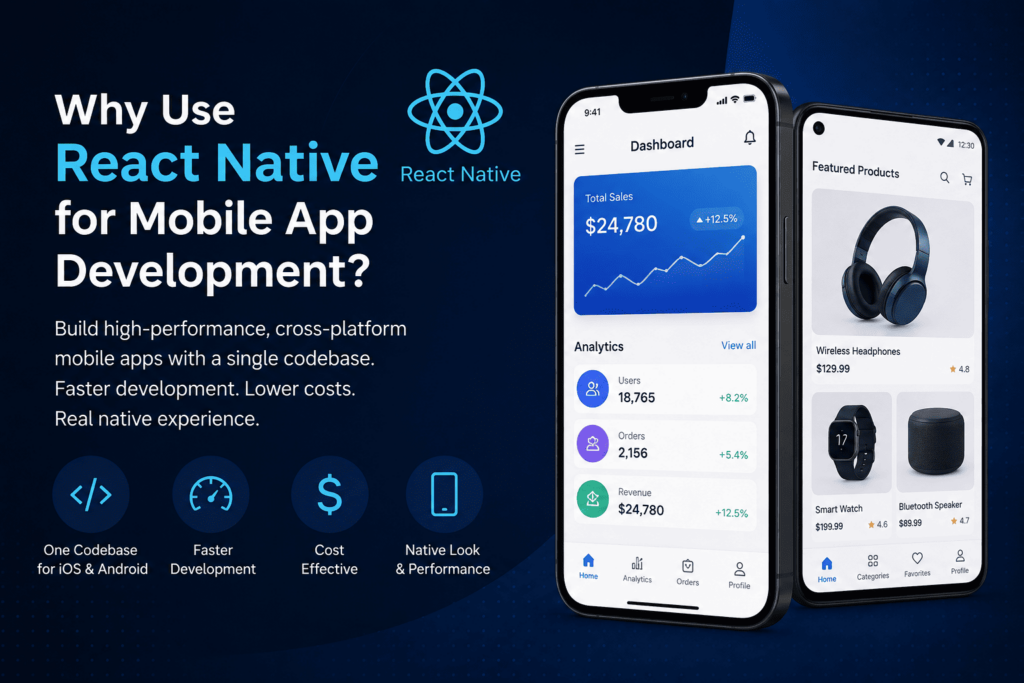





At Newpath, we’ve reached a fascinating turning point in the Australian mobile landscape. For years, the debate between “Native” (building separate apps for iOS and Android) and “Cross-Platform” was a tug-of-war between performance and budget. However, as we move through 2026, the data from our recent project deliveries suggests the debate is effectively over for the enterprise mid-market. We are seeing a massive shift toward what we call “The 40% Rule.”
The 40% Rule is simple: by leveraging React Native, our team can typically reduce initial development costs by up to 40% compared to a dual-native build, while simultaneously cutting long-term maintenance overhead by an even larger margin. But cost isn’t the only story here. It’s about how the 40% saved is being reinvested to create a superior digital ecosystem.
Understanding the architecture of efficiency
Early on, mobile cross-platform tools were often less than ideal. Websites wrapped in a mobile shell with “janky” scrolling and long load times. React Native flipped the script by letting our developers write in JavaScript while also rendering native UI components.
The framework in 2026 has reached maturity, such that the performance difference is imperceptible for business applications 99% of the time. At Newpath, we use React Native because it allows our engineers to share a single codebase across both Apple and Google platforms. This is the heart of React Native cost-effective development. We aren’t just saving money; we are eliminating the “feature lag” that used to haunt native projects, where the iOS app would get a new update weeks or months before the Android version. In the fast-paced Australian market, being first to both stores is a massive competitive advantage.
The Newpath approach: Beyond the app store
One of our core philosophies is that an app should never be an island. It needs to be a functional extension of a brand’s broader digital presence. This is why our expertise as a leader in website development in Melbourne is so vital to the success of our mobile projects.
In 2026, the lines between a high-performance website and a mobile app have blurred. By using React Native, our team can often share logic between a client’s web dashboard and their mobile application. If we build a complex pricing calculator for a construction firm’s website, we can often port that core logic directly into their mobile app. This creates a “Single Source of Truth.” When a business rule changes, we update it in one place, and it reflects across the entire digital estate—from the desktop in a Melbourne head office to the smartphone in a field technician’s pocket in Perth.
Why “Native” is becoming a niche choice
While we see value in pure native builds (Swift for iOS and Kotlin for Android), the demand has lessened, particularly by 2026. In general, we only recommend pure native builds in the following scenarios:
- High-end mobile gaming: Where every millisecond of GPU performance is absolutely essential.
- Deep hardware integration: Apps that need to access specialised sensors in unusual ways or low-level Bluetooth protocols.
- OS-specific innovation: Apps that are specifically made to demonstrate a brand-new feature of the latest iPhone before it becomes a market expectation.
For the vast majority of our enterprise clients—utilities, retailers, financial services, and member associations—the flexibility of React Native far outweighs the marginal gains of a native build. Our clients would rather have a feature-rich, polished app on two platforms today than a “perfectly native” app on one platform six months from now.
Reinvesting the “Saved 40%”
This is the part of the strategy that excites our team the most. When we save a client 40% of their development budget, that money doesn’t just disappear. At Newpath, we encourage our partners to reinvest those funds into the areas that actually drive user retention and ROI:
1. Superior UX and UI Design
Instead of paying two teams of developers to write the same code twice, we spend more time in the prototyping phase. We focus on high-fidelity animations, intuitive user journeys, and accessibility features that make the app a joy to use.
2. Advanced Personalisation and AI
In 2026, a “generic” app is a failed app. We use the budget surplus to integrate AI-driven recommendations and predictive search. We make the app smart enough to know what the user wants before they finish typing.
3. Rigorous Quality Assurance (QA)
A single codebase means our QA team can go deeper. We spend more time testing edge cases and ensuring the app performs flawlessly across the myriad of Android devices that populate the Australian market.
The maintenance multiplier
The “40% Rule” actually gets more impressive over time. The “Hidden Cost” of native development is the maintenance tail. Every time Apple or Google releases an OS update, native apps require separate rounds of testing and patching.
With React Native, we manage one set of dependencies. This halving of the maintenance burden allows our clients to pivot quickly. If a Melbourne-based retailer notices a sudden change in consumer behaviour, we can deploy a promotional feature or a new payment gateway across both platforms simultaneously. In a high-inflation, high-competition environment, this operational agility is priceless.
A strategic no-brainer
As we look toward the second half of 2026, the “40% Rule” has moved from a theoretical benefit to a proven business strategy. React Native has outpaced native development because it respects the two most valuable resources any Australian business has: time and capital.
At Newpath, our goal is to build digital products that move the needle. We give our clients a competitive edge by helping them choose a framework that offers speed, affordability, and a first-class user experience. Our focus is on constructing thriving, adaptable businesses, not just individual apps, ready to face the evolving digital landscape.
The question for 2026 is no longer “Why React Native?” It’s “Why would you do it any other way?”