




It still astounds me how many businesses run complex operational processes and make high-impact decisions using Excel as their primary tool for data and workflow. I genuinely tip my hat to Excel guns who build these solutions. From highly algorithm-driven decision tools to layered price-estimation workbooks packed with VBA macros, I’ve seen some incredible Excel “apps” that would make Charles Simonyi proud.
What surprises me even more is the number of organisations still approaching us to digitise their operations – to move from paper, email trails and spreadsheets into properly designed digital systems. These are the projects that excite me most because the value is real, immediate and tangible.
For enterprises occupying asset-intensive, regulated or service-driven sectors, “digital transformation” often translates into one very practical challenge: how do we move from spreadsheets, siloed apps and brittle workflows to something coherent, governed and genuinely easier to run?
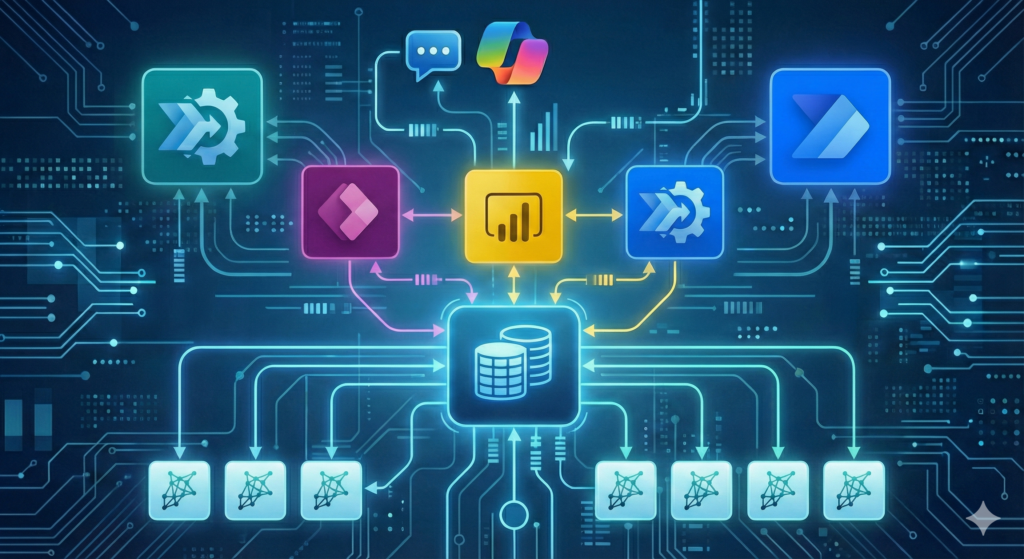
Answering this question, Microsoft Power Platform commands this space with a diverse but fully integrated set of tools spanning no/low code application development in Power Apps (model-driven and canvas), Power Automate, Power BI, Dataverse and connectors into Dynamics 365 and Azure.
But outside of migrating from spreadsheet hell and digitisation (or digitalisation depending on your scenario), the opportunity to automate, rapidly build no/low code apps, and unify datasets in a “Dataverse” can seem nebulous. Add Microsoft Fabric or Copilot Studio into the mix and the opportunities to innovate can be overwhelming.
So in this article, I draw on three client engagement scenarios to demonstrate how we are applying Power Platform in the real world…
- An international facilities management and construction business replacing “spreadsheet hell” with a model-driven project framework.
- A national registered training organisation (RTO) simplifying a complex integration stack and reducing licensing overheads through Power Automate and connectors.
- A tier 1 national construction firm digitising OHSE practices at scale with Power Apps, Power Automate and Power BI, generating multi-million-dollar savings.
From spreadsheet chaos to a model-driven project framework
Primary products: Model-driven Power Apps, Power Automate, Power BI, Dataverse, Microsoft Finance (FinOps) integration
In this first example, we worked with an international facilities management and construction business running a sizeable capital works portfolio. Their environment is very much “Microsoft-first” with their financial data sitting within Microsoft Finance (FinOps) with Power BI offering reporting capabilities. But despite that stack, a surprising amount of the complex estimations and project management workload still lived inside an Excel-based “toolkit” that had grown organically over time. For a while, those spreadsheets did the job – until they didn’t. The problems were numerous, but ultimately symptomatic of relying on Excel for core operational tasks, leading to:
- inconsistent project data and version control
- limited visibility over margins and risk
- no real-time integration to finance (Microsoft Financial / FinOps)
- limited ability to scale a “one-way, same-way” project methodology across contracts.
Newpath’s recommendation was to retain the core methodology but lift it into a model-driven solution built with Power Platform as a model-driven App:
- Dataverse + Finance as the backbone for project, financial and governance entities.
- Model-driven Power Apps reflecting the full project lifecycle – from RFT and bid/no-bid through planning, execution and closeout. Each phase’s forms, business rules and checklists became structured app experiences instead of worksheets.
- Power Automate to orchestrate stage-gate approvals, create folder structures, trigger notifications and synchronise financial data with Microsoft Finance.
- Power BI over a central data store for portfolio views: margin trends, risk registers, supplier performance and capital programme status.
- SharePoint and Teams for document management, collaboration and meeting records anchored to project entities.
The real story isn’t “we turned spreadsheets into an app.” It’s:
- Standardisation without losing nuance: a repeatable estimations and project framework applied across all capital projects.
- Live financials: near real-time integration to Microsoft Finance for stage-gate, budget and claim visibility.
- Governed data layer: Dataverse and Power Platform administration framework provides security, audit and lifecycle management, rather than locking key logic into Excel formulas.
This is a textbook pattern for moving from ad-hoc, spreadsheet-driven project management to a governed, model-driven platform – without discarding the processes that actually work. And here’s the kicker: The original data and logic model intrinsically built into the Excel app conveniently provides our design and development teams with an obvious blueprint. So, while expertise is required in building the app, much of the original, often complex, logic could be transported into the Microsoft Power Platform stack reducing the time-to-market by months.
Simplifying a complex integration and forms landscape at a national RTO
A national registered training organisation (RTO) engaged Newpath to solve cost and productivity issues. On paper, their architecture looked sophisticated: a Nintex-based forms and workflow layer sitting over a service-bus-centric integration stack, with Azure Functions, Logic Apps, Power Automate and Dynamics 365 all in the mix. Technically, it worked. But operationally, it had become complex and brittle – hard to maintain, heavily dependent on niche skills like XML/XSLT and Altova-based PDF tooling, and expensive from a licensing point of view.
In reality, Nintex was doing one main job: powering the forms, albeit expensively. The real orchestration of business processes was already happening in Azure Functions, Logic Apps and Power Automate. That imbalance is what opened the door to a more streamlined, Power Platform–centric approach.
Newpath’s analysis recommended a progressive consolidation into Power Platform, not a “big bang” rewrite:
- Replace Nintex forms with Power Apps and/or Power Pages, improving UX while consolidating into the Microsoft stack.
- Leverage Power Automate connectors to Dynamics 365 to prefill and validate data, removing custom integration layers where appropriate.
- Refactor multiple near-identical Power Automate cloud flows into generic, reusable flows, reducing maintenance overhead and failure points.
- Modernise PDF generation by replacing XML/XSLT + Altova with a template-driven API service, callable from Logic Apps or Power Automate, so non-developers can manage templates.
Commercially, the path offered two levers by reducing Nintex licensing (estimated up to ~$30k pa in RRP) and reducing development time (3–7 days saved per form change/new form) by simplifying the template pipeline.
This case shows Power Platform’s strength as an integration and rationalisation layer:
- Fewer moving parts: turning a complex web of forms, flows and bespoke PDF tooling into a more cohesive, Microsoft-native stack.
- Better leverage of existing investment: deeper use of Power Automate and connectors already in the environment.
- Pathway to future Dataverse use: once forms and flows live on Power Platform, centralising data into Dataverse or D365 becomes far simpler.
This example represents a strong pattern when you’re staring at a sprawl of form and workflow tools and need a pragmatic path back towards the Microsoft core. In a scenario like this, Fabric is also worth consideration when seeking to unify data across multiple platforms, further strengthening the data ‘spine’ of your organisation.
Digitising safety at scale for a tier 1 construction firm
In the third story, we were approached by a tier 1 national construction firm operating dozens of high-risk sites around the country. On the technology side, the organisation already had strong alignment with Microsoft technologies. On the ground, though, a lot of OHSE activity was still running on paper and region-specific workarounds. Incident and inspection reports were slow to make their way off site, visibility of safety performance was patchy at best, and both safety teams and contractors were carrying a heavy admin burden just to keep the basics up to date.
Newpath and the client’s OHSE team designed an end-to-end OHSE platform on Power Platform:
- Canvas Power Apps as the mobility layer for internal staff — delivering state-based navigation apps and 40+ safety forms, optimised for site devices and kiosk modes.
- Power Apps Portals for external contractors, providing secure web access to required forms without needing internal licences.
- Power Automate to trigger reminders, escalate open items and orchestrate workflows (e.g. inspections, audits, SWMS reviews).
- Dataverse as the unified data layer, carrying business rules, field-level security and relationships between entities.
- Azure Functions for high-fidelity PDF rendering of complex safety forms.
- Power BI dashboards providing near real-time injury, incident and inspection insights to regional and national leadership.
An MVP went live in ~6 months for one state, before being scaled nationally. Within the first 12 months of operation, the platform was estimated to have delivered multi-million-dollar savings in time and process efficiencies, alongside stronger compliance assurance.
This is the Power Platform operating as a full product stack:
- Apps for internal and external users
- Automated workflows and events
- BI and insights over a consistent data model
- Extension via Azure where highly bespoke outputs are required.
It’s a compelling example of moving from point solutions to a genuinely platform-led safety ecosystem in a highly compliance driven environment. Completed in 2020, the project was an incredible success and still remains in use today – a solution built to last. With an exceptionally low Total Cost of Ownership, the relatively low investment has been returned many times over.
The methodology to deliver these outcomes differed for each project. Due to the nature of these highly integrated, automated, data-reliant projects we cannot afford to take a one-size-fits-all approach. In the latter example, we deployed a design thinking methodology bringing the stakeholders along for the journey ensuring there was buy-in throughout the process. Trust in the process, technical leadership, and strong project/risk governance was essential to successful delivery.
In comparison, the first two examples demonstrate a more linear approach where the business case and technical specification were prescriptive. While complexity existed, the solution was well understood from the outset. In all cases, defining the project method and seeking endorsement from project sponsors and key stakeholder groups is an important first step setting the tone for success.
Finally, if you’re considering how to use (or expand) Power Platform in your environment, these use cases translate into a few concrete questions:
- Where is spreadsheet “madness” still running critical processes?
Could a model-driven app plus Power BI deliver better control without losing the nuance those sheets capture?
- Where are you paying twice for forms and workflow tooling?
Rationalising onto Power Apps, Power Pages and Power Automate may simplify both licensing and skills.
- Which safety, compliance or service processes are still paper-heavy?
Canvas apps and portals/Pages can bring those into a mobile, auditable world quickly – especially where you already have M365.
- Do you have a coherent data layer?
If not, investing in Dataverse and/or Fabric will amplify the value of every future app, flow and BI report. With a strong data spine, AI-driven data insights become a very real and feasible prospect.
How Newpath can help
Newpath has been designing and delivering Power Platform solutions across construction, facilities management, education, aged care, disability and other sectors for close to a decade – from spreadsheet-to-platform migrations through to national OHSE rollouts and integration-heavy automation programs. Speak to one of our experts today.